Tuesday, November 29, 2011

Guest Post: Feeding a Large Flock Without Going Insane

I have had seven birds or more in my house at any given time, between flock members and foster birds. All this, and a busy life taking care of other people’s birds too! Feeding a healthy diet to my birds is important to me, but I just don’t have all day (who does?). As many of us know, feeding a fresh diet requires thinking first thing in the morning before we leave for work, and this is something I am not very good at. I also don’t have tons of money. So buying lots of the “instant” bird mixes and cooking them up isn’t always an option. So how do I balance the time and money issue?

I got organized! I created a feeding schedule/calendar that helps me ensure that I am feeding a balanced diet to my flock. This way, I buy all the right groceries when I’m at the market, and my plan gives me a weekly and daily task list of what I need to do, and when. (Since much of the prep for a fresh bird diet happens in the wee hours of the
morning before work, I needed to tell myself what needs to get done in advance. I’m just not adept at thinking on my feet early in the morning.) I found that bird care for a larger flock can get overwhelming unless you plan in advance.

Below are sample make-ahead recipes of a bird balanced diet. You can set aside 30-60 minutes a week to make bird food and freeze and store your work for fresh food-on-the-run! I tend to do my weekly prep on Sundays, when I have the time.

Making bird recipes is often easier than people ones, and
kids love to help in the kitchen!
I often set one day aside a week to offer seed and nuts and treats above and beyond the ordinary daily nutrition. This gives me a prepping break, as pleasing to the birds, and makes time when you just want to hang out and not do work (or you have chores to do and want little distraction!) doable. We call this day “Seed-ter-day” in my house. “Seed-ter-day” allows the birds to have a treat while we are out during the day, having fun together, or doing chores. The rest of the mornings, we eat as a flock, but it’s all easy food that doesn’t need prep (or is prepped on Sunday and pulled out of the fridge).

I feed 100% organic, and animal products (like eggs) are also free range. I am lucky since in the Bay Area, I can get an organic “box” delivery: produce, cereals, nuts, and juices delivered every Wednesday! I also love Trader Joe’s supermarket- they carry tons of organic stuff- from pine nuts to eggs!

As far as processed bird products, I use a variety of pellets (all human grade, preferably organic).


Every week, set aside 30 minutes or so on one day (usually Sunday) to do bird food prep. Here are things you might want to make in advance that would make your week easier:

Hard boil eggs in advance. Serve these chopped, with the shell included.

Sweet Potato Balls (recipe has appeared on this blog)

Rice Mix with veggies (Steam veggies of choice while rice is cooking; mix together until blended. I have a rice cooker with a steamer basket and highly recommend one- and it’s great for making human food, too. It is self contained, has automatic shutoff, and takes up very little space while you are working.)


Birdie Bread Mini Muffins

Veggie ravioli with healthy veggie-laden marinara (humans eat this too!)

Make 7 layer salad  (recipe has appeared on this blog)

Make Spicy Ricey Glop  (recipe has appeared on this blog)

Prep a sprout mix

When you do your bird feeding chores once a week, it really saves time and energy- leaving your spare time to socialize and spend quality time with your flock-not your food processor!

Now through 12/5, enter code largeflock to get free shipping on orders over $100!

Tuesday, November 22, 2011

Bird Recipe: Home-made "avi-cakes"

This is a recipe provided by a Mommabird client. These are for treats only, not a main diet! We thought with the upcoming Thanksgiving holiday, you could use a treat recipe!

Homemade Avi-Cakes

Mix in 2 cups each of three desired ingredients (below are examples)
(pick three things for a total of 6 cups of dry ingredients)

crushed cereal….. (Cheerios or Shredded Wheat..)
crushed pellets
instant oatmeal (rolled oats)
assorted seeds…..

Add honey or karo corn syrup, about 1 1/4 cups
(see why this is a treat? FYI: Avi-cakes are also sweetened- heavily!)


Directions:
1. Stir until mixture is wet but not dripping. You may need to adjust the honey or dry ingredients to get it this way.

2. Pour it onto a cookie sheet, spread it out and bake at very low temperature like 200 F for about 45 minutes.

3. About half way through cooking, I usually score them it makes it easier to cut them when done.
You can also shape these around craft sticks with a hole drilled at one end for a hanging treat in the cage

4. These make terrific stocking stuffers or birthday gifts for the birds. My birds go crazy for these!

Now through 11/29, enter code givethanks IN THE COMMENTS BOX (NOT THE COUPON BOX) to get a free bag of Harvest Loaf with orders of $50 or more.

Tuesday, November 15, 2011

Over-the-Counter Medicines and Birds

Why should you avoid giving your bird ANY meds without first seeing an avian vet?

1. While saving money is important in these times, saving your bird is even more so. Most over-the-counter medications (especially the antibiotics) DO NOT WORK. They are too weak to do the job you want them to do.

2. You also may be using an improper medication, as you are not a vet and have done no tests to determine what the problem is with your bird. (Commonly people treat for bacteria when their bird has yeast- I’ve seen that one plenty of times.)You will either wind up taking your bird to the vet after using these meds anyway or having the bird die, I guarantee you.

3. Further, using these “medicines” will skew the tests that the vet will inevitably need to do, thereby delaying proper treatment even further.

Do your bird a favor- when it seems sick, take it to a (preferably Board Certified) Avian Vet. Get it tested and get the real stuff. Your bird will thank you.

Any store that would sell you over-the-counter medicines is a bad store, period. They just wanna sell you something, even if it means killing your bird or extending its suffering in the process. There’s even one that “vets” put their name on that will do this, and it has gotten them in trouble with their vet peers- because it is unethical to take advantage of people using your vet reputation and degree to sell snake oil.

Now through 11/22: enter code noOTCforme to get free shipping on your order of $75 or more!

Tuesday, November 8, 2011

Bird Recipe: Dry Mix

This idea is a real time saver for me: I make a monthly “dry mix” for my parrots that allows me to serve variety with little time investment. I keep it in an airtight pet food container with a scoop inside to make it easy to serve my flock. 

I always have a “dry bowl” in the cages and on parrot play stands. Because it isn’t filled with moist foods, it can stay there all day with less fear of bacterial buildup. I also have a “wet bowl” at flock meals (at the table with us in the morning and evening).

Dry mix is what you make it. You can add your bird’s favorites to new items and see if there is interest as you come across them. Serving dry mix also reduces incidences of “food fear” (when a parrot is naturally suspicious of new food items and gets freaked out), because the new item is surrounded by the familiar mix.

My dry mix ingredients for my two Caiques:
1. Pellets: Zupreem Natural Conure, Hagen Tropican Parrot Sticks, Breeder’s Blend, Foundation Formula Spicer’s Blend, or Harrison’s Coarse. (Some of these brands are not my main organic brands, but I am OK with these brands in smaller quantities).

2. dried chilies (whole red hot ones)

3. dried unsulphured fruits (coconut, raisins, cranberries, raspberries, blueberries, pineapple, mango, and papaya. )

4. dried seeds (pepitas, flax seed, buckwheat groats, quinoa)

5. whole grain unsweetened cereal

6. dried veggies and legumes (carrot, beets, peas, broccoli, soynuts, and bell pepper)

Ingredients are not in order of quantity or anything- when I find a deal on something great for the mix, I splurge on that. So sometimes the mix is veggie heavy, other times it is pellet heavy.

Now through 11/15,  enter code drymix to get free shipping on orders over $100!

Tuesday, November 1, 2011

How Much Does Your Bird Weigh? Is s/he healthy?

Here are the suggested weights these specific birds should be in (listed from lowest female weight to highest male weight). All in GRAMS.

African Grey: 300-380
Blue Crowned Conure: 84-96
Blue Headed Pionus: 238-278

Blue and Gold Macaw: 892-1294
Budgies: 30-60

Canary: 12-29
Cockatiel: 82-125
Diamond Dove: 40
Double Yellow Headed Amazon: 545
Eclectus: 383-524
Greater Indian Hill Mynah: 180-240

Green Winged Macaw: 1058-1464
Jenday Conure: 118-128

Lovebirds: 50-70
Moluccan Cockatoo: 640-1025
Orange Winged Amazon: 440-470
Scarlet Macaw: 1058-1464
Senegal: 125-150
Umbrella Cockatoo: 458-756
Yellow Collared Macaw: 223-308
Zebra Finch: 10-16

Now through 11/8, enter code weighthatbird for a free bag of birdie bread for every three you buy!

Tuesday, October 25, 2011

Choice: Something We Often Overlook Giving Our Parrots (Guest Post)

We all know parrots are intelligent social creatures. That’s why we choose them as companions! But as smart creatures, they certainly do give up a lot of autonomy to be our pets. In the wild, they have lots of decisions to make and this stimulates their intelligence and creativity. But we control virtually everything in a companion parrot’s life: food or famine, light or darkness, where they go and what they do. Is it any wonder these birds “act out” for “no apparent reason”?

I am a firm believer in offering choices on a daily basis to my flock. I believe it makes a happier, healthier, more intelligent bird and a more harmonious household. But when I tell many people about the merits of offering choice to their parrots, many folks panic. They think “Chaos! Birds ruling the roost!”, and fear a lack of control.

I assure you, you CAN create room for choice and still have domestic tranquility. To that end, I offer a few tips- things we use here at Squawk Central.

So here are some tips to introducing healthy choices into your home life:

Food Choices:
While I want to control what my bird eats for optimum nutrition, there is flexibility as long as all the choice options being offered are healthy. Allowing a choice between two or three healthy options makes a bird feel good (and they still get good food to eat). Here are a couple ways I allow this to happen in my home:

“Pick from the Bin”: Often, I’ll create a bin of layered salad, dry items, or mixed foods and store it in a Tupperware for feeding through the week. While many folks also do this, they often plop the items in a dish, thereby eliminating choice on the part of the bird. Instead, try holding the bin up for the bird to see the contents and ask them to choose what they want. My birds get so excited about making a choice, they all clamor simultaneously onto one perch to get closer to the bin!

Mixed Dishes: I feed two flock meals (AM and PM out at the table with us) and also offer dried food in the cages at Squawk Central. Both wet and dry dishes always have a variety of ingredients in them, allowing the bird to choose the favored nugget of the day. I have found that when food is offered this way, birds don’t always go for the obvious (less healthy) option. My birds tend to cycle in what is the trendy food item du jour.

Interconnected Food Stands: My birds all eat flock meals together at the dining room table. There are meal stands on the table for them (perches with food cups attached). Rather than enforcing territorial boundaries, I allow them to hop from one stand to another picking and choosing what they eat and where they eat it. All the birds seem to like to “forage” in this way.

“Step Up” versus “Wanna Come?”:
Many people inadvertently bully their birds by commanding them to “step up”, even when all they want to do is invite the birds over for affection.  Personally, I only use the cue, “Step Up” when it is mandatory- and my birds comply with that cue.
But most of the time, I use, “Wanna Come?”. The difference between the two terms is one offers a true choice (“Wanna Come”), one means you MUST (“Step Up”). I truly give my birds the choice whether they want to be with me or not. Many times they choose scritches, but sometimes they don’t. I don’t allow my ego to be bruised if one decides they’d rather flap around on the atom gym than be with me.
Once I started offering a true choice, I found that my birds more often came over to me socially without invitation- and that was an unintended consequence, but it makes sense if you think about it- and it was a welcome surprise!

Flighted versus Clipped:
This can be a contentious issue for many folks, and I see the merits in both sides of the argument. Since this article is on choice, I am keeping my arguments for and against flight about offering choice. There are other reasons for and against flight as well, but that is for another article. I personally started out as an avid “pro clipper” for safety reasons. I have NEVER believed in clipping for behavioral or “training” reasons.)
I am now a situationalist on the subject- I personally have flighted parrots. I believe that being flighted is preferable to being clipped IF (and only IF) the human can provide for such a responsibility. (I bird-proofed my home and all humans are in on the project, so safety inside is not an issue. We have a door plan that involves using the back door (away from the birds when they are out) so that inadvertent escape is very unlikely. My birds are socialized and cooperative.)
Personally, I believe leaving a bird flighted is better for their self esteem, health, and offers choices that clipped birds don’t have. For example, I have several play areas in my interconnected living and dining room that my birds fly to and from while they are out. They can hang out with one another, get some alone time, fly to get a snack from a food cup, or get some exercise. All of this is within their reach- and all because they do not rely upon me to move them from place to place.

Play Areas versus “a stand”:
There are many products out there calling themselves “gyms” or “stands” or “play areas”. I have found that no one product is enough to meet the needs of my flock. So I have gradually accumulated and built more and more and have incorporated them into my birds’ landscapes when time, space, and money allows. When I only had one “bird tree” for each of my birds (and I kept them to their specific tree), I soon found them insufficient. Even loading them up with toys and rotating those toys did not alleviate boredom and stimulated their minds in the way I wanted that product to.

I stumbled upon the current way I do things organically- I kept getting more and more gyms, and rather than putting an old one away, I would just add to the mix of what was available for my birds. For space reasons at the time, I put hanging gyms directly above an existing floor or tabletop gym, inadvertently making an interconnected area where the bird could go up and down easily. BINGO! Without even trying to do so, I started to offer my birds choices and some freedom of movement.
The results were astounding- my birds are calmer, get along better and have less “territorial disputes”. In our last home, all the bird cages and gyms were in the same room (the living room), and we interconnected the cages with the play areas, so that the birds had more “real estate” to occupy. We found that leaving the cage doors open and allowing birds to travel them (as well as the gyms) freely did not cause arguments.

To the contrary, unlike many bird owners who report cage or gym territoriality, I found that the birds tended to see their own cages as “flock territory” rather than as a personal nesting site after I started opening the cage doors. We found that natural cross-species friendships were created and thrived. We also learned a lot about avian aesthetic and feng shui  preferences when all birds in the flock decided that Buddy’s cage was THE place to be. We jokingly called her cage the “dorm room”. This change in what a cage means symbolically has meant translated into no more egg laying in my hens as well. That was a welcome side effect!

Toys, esp. Manipulative and Foraging Toys:
Toys are more than just playthings. Parrot toys are tools that a human uses to harness wild instinctual behavior in a companion parrot and channel them into appropriate behavior that is suitable for a human home. To that end, there are many types of parrot toys: Foraging, Preening, Manipulative, Athletic, Interactive, and Destructible. And offering a complement of all types allows choice for your parrot. Specifically, I want to talk about Foraging and Manipulative Toys and how they offer choices to your parrot.

This post was written by the founder of Squawk and Howl. She is a parrot behaviorist, rescuer, and companion. 

Now through 11/1, enter code spookydeal to get a great deal at Momma Bird's Store! Free shipping on orders of $75 or more!

Tuesday, October 18, 2011

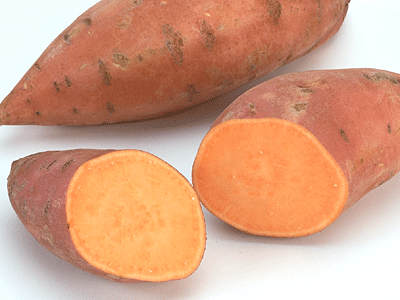
Bird Recipe: Sweet Potato Balls

We know that you would not be here if your bird didn't love Momma's Birdie Bread! But we figured we'd share some of our flock's other fave recipes to supplement your bird's diet!

Sweet Potato Balls

1 lg sweet potato - baked and skinned
1/4 c flax seed
1 tablespoon spirulina (optional)
1 cup veggies  (I tend to use finely chopped broccoli or zucchini)
1 1/2 c uncooked oatmeal or steel cut oats
fruit juice of choice

Mix all until well assimilated and add enough fruit juice to make small balls.
To freeze: place balls on cookie sheet. Once they are frozen, you can transfer to a bag (they won’t mush together in the freezer this way.)

Now through 10/25, enter code sweetpotato for a free bag of birdie bread when you buy three!