We all know parrots are intelligent social creatures. That’s why we choose them as companions! But as smart creatures, they certainly do give up a lot of autonomy to be our pets. In the wild, they have lots of decisions to make and this stimulates their intelligence and creativity. But we control virtually everything in a companion parrot’s life: food or famine, light or darkness, where they go and what they do. Is it any wonder these birds “act out” for “no apparent reason”?
I am a firm believer in offering choices on a daily basis to my flock. I believe it makes a happier, healthier, more intelligent bird and a more harmonious household. But when I tell many people about the merits of offering choice to their parrots, many folks panic. They think “Chaos! Birds ruling the roost!”, and fear a lack of control.
I assure you, you CAN create room for choice and still have domestic tranquility. To that end, I offer a few tips- things we use here at Squawk Central.
So here are some tips to introducing healthy choices into your home life:
Food Choices:
While I want to control what my bird eats for optimum nutrition, there is flexibility as long as all the choice options being offered are healthy. Allowing a choice between two or three healthy options makes a bird feel good (and they still get good food to eat). Here are a couple ways I allow this to happen in my home:
“Pick from the Bin”: Often, I’ll create a bin of layered salad, dry items, or mixed foods and store it in a Tupperware for feeding through the week. While many folks also do this, they often plop the items in a dish, thereby eliminating choice on the part of the bird. Instead, try holding the bin up for the bird to see the contents and ask them to choose what they want. My birds get so excited about making a choice, they all clamor simultaneously onto one perch to get closer to the bin!
Mixed Dishes: I feed two flock meals (AM and PM out at the table with us) and also offer dried food in the cages at Squawk Central. Both wet and dry dishes always have a variety of ingredients in them, allowing the bird to choose the favored nugget of the day. I have found that when food is offered this way, birds don’t always go for the obvious (less healthy) option. My birds tend to cycle in what is the trendy food item du jour.
Interconnected Food Stands: My birds all eat flock meals together at the dining room table. There are meal stands on the table for them (perches with food cups attached). Rather than enforcing territorial boundaries, I allow them to hop from one stand to another picking and choosing what they eat and where they eat it. All the birds seem to like to “forage” in this way.
“Step Up” versus “Wanna Come?”:
Many people inadvertently bully their birds by commanding them to “step up”, even when all they want to do is invite the birds over for affection. Personally, I only use the cue, “Step Up” when it is mandatory- and my birds comply with that cue.
But most of the time, I use, “Wanna Come?”. The difference between the two terms is one offers a true choice (“Wanna Come”), one means you MUST (“Step Up”). I truly give my birds the choice whether they want to be with me or not. Many times they choose scritches, but sometimes they don’t. I don’t allow my ego to be bruised if one decides they’d rather flap around on the atom gym than be with me.
Once I started offering a true choice, I found that my birds more often came over to me socially without invitation- and that was an unintended consequence, but it makes sense if you think about it- and it was a welcome surprise!
Flighted versus Clipped:
This can be a contentious issue for many folks, and I see the merits in both sides of the argument. Since this article is on choice, I am keeping my arguments for and against flight about offering choice. There are other reasons for and against flight as well, but that is for another article. I personally started out as an avid “pro clipper” for safety reasons. I have NEVER believed in clipping for behavioral or “training” reasons.)
I am now a situationalist on the subject- I personally have flighted parrots. I believe that being flighted is preferable to being clipped IF (and only IF) the human can provide for such a responsibility. (I bird-proofed my home and all humans are in on the project, so safety inside is not an issue. We have a door plan that involves using the back door (away from the birds when they are out) so that inadvertent escape is very unlikely. My birds are socialized and cooperative.)
Personally, I believe leaving a bird flighted is better for their self esteem, health, and offers choices that clipped birds don’t have. For example, I have several play areas in my interconnected living and dining room that my birds fly to and from while they are out. They can hang out with one another, get some alone time, fly to get a snack from a food cup, or get some exercise. All of this is within their reach- and all because they do not rely upon me to move them from place to place.
Play Areas versus “a stand”:
There are many products out there calling themselves “gyms” or “stands” or “play areas”. I have found that no one product is enough to meet the needs of my flock. So I have gradually accumulated and built more and more and have incorporated them into my birds’ landscapes when time, space, and money allows. When I only had one “bird tree” for each of my birds (and I kept them to their specific tree), I soon found them insufficient. Even loading them up with toys and rotating those toys did not alleviate boredom and stimulated their minds in the way I wanted that product to.
I stumbled upon the current way I do things organically- I kept getting more and more gyms, and rather than putting an old one away, I would just add to the mix of what was available for my birds. For space reasons at the time, I put hanging gyms directly above an existing floor or tabletop gym, inadvertently making an interconnected area where the bird could go up and down easily. BINGO! Without even trying to do so, I started to offer my birds choices and some freedom of movement.
The results were astounding- my birds are calmer, get along better and have less “territorial disputes”. In our last home, all the bird cages and gyms were in the same room (the living room), and we interconnected the cages with the play areas, so that the birds had more “real estate” to occupy. We found that leaving the cage doors open and allowing birds to travel them (as well as the gyms) freely did not cause arguments.
To the contrary, unlike many bird owners who report cage or gym territoriality, I found that the birds tended to see their own cages as “flock territory” rather than as a personal nesting site after I started opening the cage doors. We found that natural cross-species friendships were created and thrived. We also learned a lot about avian aesthetic and feng shui preferences when all birds in the flock decided that Buddy’s cage was THE place to be. We jokingly called her cage the “dorm room”. This change in what a cage means symbolically has meant translated into no more egg laying in my hens as well. That was a welcome side effect!
Toys, esp. Manipulative and Foraging Toys:
Toys are more than just playthings. Parrot toys are tools that a human uses to harness wild instinctual behavior in a companion parrot and channel them into appropriate behavior that is suitable for a human home. To that end, there are many types of parrot toys: Foraging, Preening, Manipulative, Athletic, Interactive, and Destructible. And offering a complement of all types allows choice for your parrot. Specifically, I want to talk about Foraging and Manipulative Toys and how they offer choices to your parrot.
This post was written by the founder of Squawk and Howl. She is a parrot behaviorist, rescuer, and companion.
Now through 11/1, enter code spookydeal to get a great deal at Momma Bird's Store! Free shipping on orders of $75 or more!
Tuesday, October 25, 2011
Tuesday, October 18, 2011
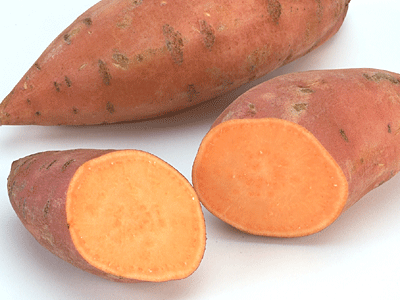
Bird Recipe: Sweet Potato Balls

Sweet Potato Balls
1 lg sweet potato - baked and skinned
1/4 c flax seed
1 tablespoon spirulina (optional)
1 cup veggies (I tend to use finely chopped broccoli or zucchini)
1 1/2 c uncooked oatmeal or steel cut oats
fruit juice of choice
Mix all until well assimilated and add enough fruit juice to make small balls.
To freeze: place balls on cookie sheet. Once they are frozen, you can transfer to a bag (they won’t mush together in the freezer this way.)
Now through 10/25, enter code sweetpotato for a free bag of birdie bread when you buy three!
Tuesday, October 11, 2011
Hospital Tanks
![]() |
| Sick parrot? |
Therefore, it has no perches they must balance on- it is a small enclosed space with a flat bottom. It is soft on the bottom (towels are great for this). It has easy access to food & water, and is kept warm on one half of the enclosure (one half, so that if the bird feels overheated, it can self-regulate by going from one end to another).
If you have birds, you need to have one of these already. You don’t want to be unprepared in an emergency and have to leave your bird in critical condition while you search for one at the 24 hour pet store (is there such a thing?).
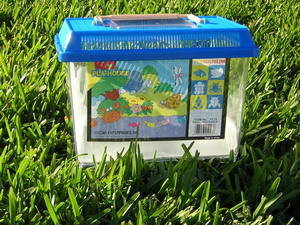
For small birds, a “critter keeper” (used to temporarily house hamsters, mice or tarantulas) works very well. For medium birds, a small cage with perches removed is good and for large birds, a large dog kennel or rubbermaid storage bin works well.
(Here’s what a critter keeper looks like):

Things you must have for your hospital tank:
1. heat source.
Half of the hospital tank is warmed by a heating pad (outside the cage, not in) or a ceramic or infared heat bulb. It is important to keep sick or injured birds at least 85-90 F (29- 32 C). The other half is kept at room temperature, so that they can regulate their own temperature by walking from one side to another. Be sure and monitor the temperature on the warm side. Sometimes things get a little too hot, especially if the heat source is directly touching the tank. Panting is a sign that they are overheated and you should try a different method or turn it down.
2. easy access to food and water.
I use small heavy shallow ceramic crocks in my hospital tanks. They do not easily tip over and are easily accessed by a sick bird.
3. towels.
Clean ones to change on the bottom (note: pick tightly woven discloths rather than looped terrycloth for small birds- their tiny talons get caught in the loops, causing them to fall and struggle) and one to drape over part of the tank to calm the bird down.
4. food- any food that the bird will eat.
Now is not the time to be persnickety about avian nutrition. A bird can take a serious nosedive if not eating when sick or injured.
Think: they poop about every 15-20 minutes. Their metabolisms are really fast. They need a constant source of high energy food. So if your bird won’t eat their regular nutritious diet, lure them with something they love but isn’t all that great nutritionally- millet spray, peanut butter, avi-cakes, whatever!
If your bird is really going downhill fast and needs a last minute boost as you are taking them to the vet, strong black coffee with sugar, administered with a dropper or syringe can make the difference between life and death. This is not something you would normally give them, as it is hard on the organs, but it can kick start their metabolisms in an emergency.
Now through 10/18, enter code hospitaltank to get free shipping on your order when you get $50 in toys.
Tuesday, October 4, 2011
Converting Birds to a Healthy Diet (Guest Post)
![]() |
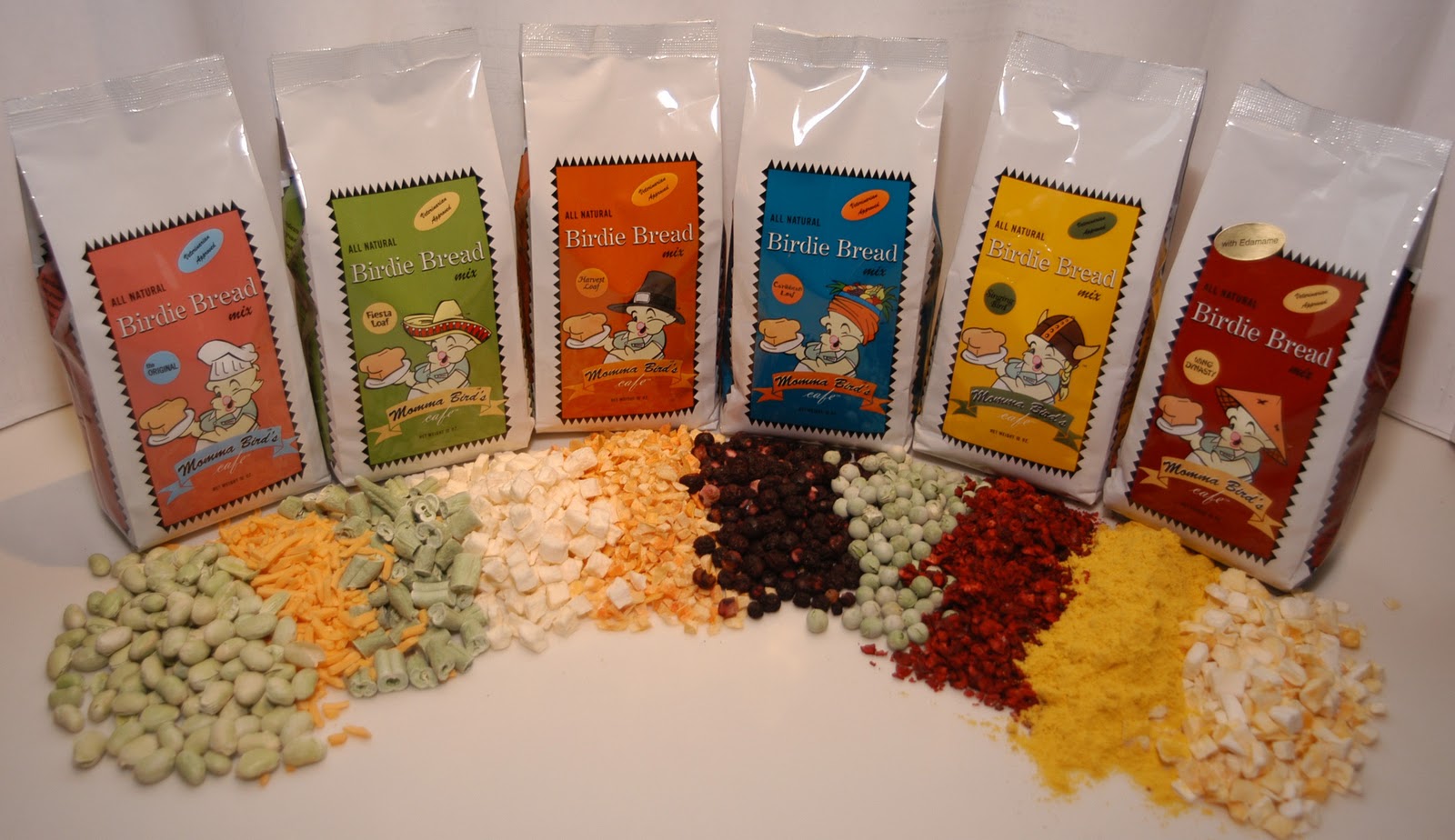
| The six original flavors! |
Despite some pet food manufacturer’s claims, there is no such thing as a “total diet” for a parrot- be it pellets or seed based mixtures. A healthy psitticine diet must include fresh foods (vegetables, greens, fruit, and proteins. Momma Bird's bread contains fruits, veggies, seed, and grain and is a great base from which to start. Formulated diets (a.k.a. “pellets”) are a handy shortcut to a varied diet- but are not the “be all and end all”. There is no substitute for the vitamins, minerals, and amino acids that occur in fresh food.
Conversion to a new diet requires that you watch your bird for signs of weight loss or ill health. Even after your bird appears to be converted, continue to watch his weight for at least a month after the apparent conversion. In most birds, the color of his dropping may change (typically from green to a brown if he has been converted to a pellet based diet, and more liquid-y as fresh foods are consumed).
An all too common scenario for many parrot owners is getting a bird that is eating an unhealthy diet and having to persuade that (usually stubborn) bird to eat better- especially in a rescue situation. So, how does one get a parrot (who is, of course, a prey animal and therefore naturally suspicious of new things) to eat better? The key is persistence, daily efforts on the part of the human caregiver, and a few tips and tricks along the way that use the bird’s instinctive behavior in the process. Conversion will without a doubt be the most difficult part of feeding your bird a healthy diet, but proper nutrition is important. Remember, this is a long-term project, one that needs to be worked on daily with your companion parrot.
NOTE ABOUT PARROT BEHAVIOR:
Parrots tend to eat twice daily -an AM and a PM meal (with a bit of grazing here and there during the day). They are also social flock eaters, and are happiest when their “flock” (that’s you and the members of your household- human and avian) eats together. Use these two facts to your advantage when trying to get the bird to eat better.
Tip #1: Eating as a Flock
![]() |
| Foraging from a plate on the table. |
Quite simply, birds want to eat what you are eating. They are more likely to try something that others in their flock are eating. If you don’t already do so, eat meals with your parrot, and keep that routine. If you have one adventurous bird, introduce that bird to the new food first- with the others watching. In my house, that bird is Tallulah. She will eat anything- on the first try!
Not only will eating as a flock help you with diet conversion, but it has other behavioral benefits, too. It will reinforce flock bonds with everyone at that meal- a bonus if you have a parrot that is overly bonded with one family member and aggressive to another! Another bonus is introducing a new flock member is easier if they share meal and bath time (yet another flock activity).
When eating a meal together, be sure the parrot has a place that they are comfortable- like an eating stand from Sandy Perch. Why do I like them in particular? You can use two different sized detachable cups, they are better balanced for many sized birds using the same stand (unlike the cheaper brand that shall remain nameless), it is natural wood coated in Sandy Perch material (as opposed to concrete in a dowel shape)- which is better for feet, and Sandy Perch material is great for sloughing beaks as they wipe them clean after eating! (By the way, that was NOT a paid advertisement!)
![]() |
| Mine love to grip the mini-muffins. So I prepare my birdie bread this way to encourage good nutrition. |
Be sure that you have one or two choices on your plate that is healthy for the bird to eat, in addition to “bird food” that you are attempting to get the parrot to try. (And be sure and thank your parrot for finally getting you to eat better!)
And if you tend to linger at meals (as we do) and want to continue to enjoy them, be sure and have foot toys, small play areas, etc. set up so that your bird can stay and enjoy that time, too. Atmy home we have a play area near the table for birds that finish early.
Tip #2: Weaning Method (from Seed to Pellets as the Base of a Cage Diet)
For birds that have more cage time than free time, most meals are taken in the cage. This makes for a harder conversion process, as this way of eating (not eating meals as a flock) is less natural and instinctive for the bird, and they tend to take comfort in the familiar when forced to eat this way.
Even if your birds do eat meals with you, they also will eat a bit in their cages/on their gyms during the day as well. So, how to wean them off a seed based diet at those times?
![]() |
| This destruction is natural and normal. Be prepared! |
Taking advantage of the AM/PM meal schedule most birds keep, offer a small amount of seed for an hour twice daily. Take the seed away after an hour, and in the same familiar dish, put the pellets instead for the rest of the day.
Gradually, as you observe that the bird is starting to eat the pellets, lessen the amount of seed offered and the amount of time it is offered each day until conversion is complete. Using this method, I have converted birds in a week or less.
NOTE: Place the pellet dish near the highest perch in the cage. This increases the possibilities of eating this food.
Tip #3: Familiarity Helps
If you are trying to get your bird to eat vegetables or pellets and they do have a food that they love, use a piggybacking method to get them to try new things.
For example, if your bird loves bread, bake birdie bread with veggies inside (if your bird objects to large chunks, puree the veggies!). Or use pellet “mash” as a substitute for a part of the flour. Birdie bread freezes well, and I bake mine in mini muffin (bird sized portions!) tins and freeze in a zipper freezer bag.
If your bird loves pasta, serve veggie ravioli. You can even make your own easily using wonton wrappers from the supermarket. Spoon the filling mixture (which you pureed in a food processor) onto one wrapper and fold over. Use water as “glue” to seal the edges. You can store wonton skins in the fridge for a couple weeks, and freeze the filling so you can have an easy batch ready to go!
If your bird likes dried corn (or another dried fruit or veggie), get a high quality mix that has this ingredient in it. (Goldenfeast and Hagen Tropimix are wonderful human grade brands to try).
If your bird gets those “treat sticks” (which are seeds with a sugar binder- only good as a treat, not in the cage permanently, okay?), try something that looks similar, but with healthier ingredients. You can make it in your oven using granola recipes as a basis- cook at a low temp (say 200 F) for a longer period- so that your oven is acting more as a dehydrator than an oven.
Tip #4: Sweeten the Deal
![]() |
| Know your bird's preferences! This is my birds' fave flavor. |
For example, soaking it in water or apple juice and creating a mash out of it. (If you try this, please note that this food cannot be left all day, since they start to spoil quickly. Maximum: 2 hours.) Many birds might try this, but here’s the catch: not all pellets are in a mashed form. You will have to crush them with a rolling pin or buy a ready-made mash, such as the Harrison’s brand, however, does have a mashed form made primarily for finches that is also good for converting picky birds if you find this is the only way to get your bird to try pellets.
Cookie Dough Method: Another way to convert a bird is to mix Harrison’s Fine Grind and your bird’s seed, cover with water & wait 5 minutes. Stir with a fork until the mix has a cookie-dough consistency. Feed this (with perhaps a few seeds pressed into the top to get the bird started) daily. Only make as much as the bird can eat for two days, max. Store in fridge. This is much better than mixing pellets and seed together dry, as the bird will eat crushed pellets and get used to the taste.
Combine cooked pasta, a favorite strained baby food flavor (like carrots or applesauce) & stir in the pellets.
Pulverize pellets & add to favorite soft foods.
Push pellets into soft cooked beans, a piece of cheese, sweet potato, cooked carrot, or bread.
Make a tiny peanut butter & pellet sandwich.
Hope these tips inspired you to take the plunge. Cooking for your birds and eating together is really satisfying, so I highly encourage it. There are umpteen ways to convert birds to a healthier diet. The only limit is your imagination!
This post was written by the founder of Squawk and Howl. She is a parrot behaviorist, rescuer, companion, and friend.
Now through 10/11, enter code healthyishappy and get a bag of birdie bread free when you buy $50 in toys.
Tuesday, September 27, 2011
Caiques!
Hi, my name is Lily, and my birds loooove Momma's Birdie Bread! So much, in fact, that I offered to write this post all about them and their species. My post is all about that particular species of parrot that has captured my heart, the Caique.
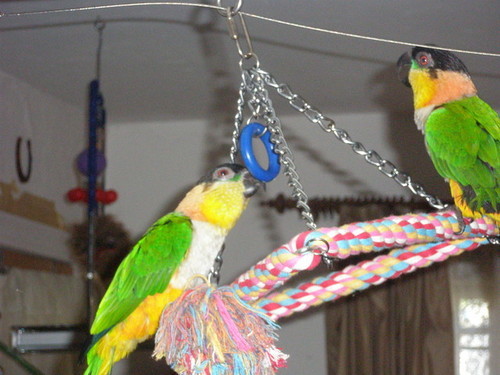
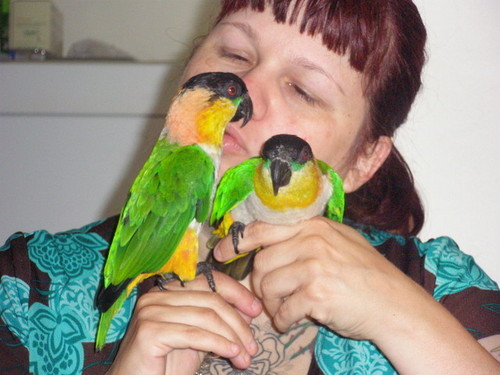
Not that we don’t love all parrots, after all- they are all amazing. But I have a soft gushy place in my heart for Caiques. I have two Caiques, named Tengu and Tallulah (aka “Goo and Loo” or “T and T (dyno-mite!)”).

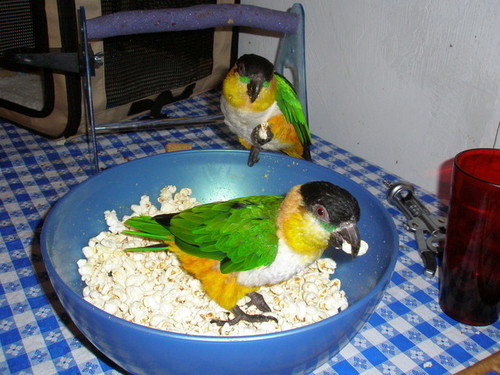
Loo is daintily perched on the rim, while Goo is full on IN the popcorn.
Caiques (pronounced “ky-eeks”) are two species of small, brightly colored parrot in the genus “Pionites”.
Origin:
They originate from the area of the Amazon Rainforest of northern Brazil and southern Venezuela, and the Guiana highlands. The Black-Headed Caique (Pionites melanocephala- like Goo and Loo), originates from North of the Amazon and westward to parts of Venezuela, Ecuador and Peru. The White-Bellied Caique's (Pionites leucogaster) habitat is South of the Amazon, from northern Brazil and spreading to parts of Bolivia, Ecuador and Peru.
Appearance:
The Black-Headed Caique (BHC) is slightly smaller than the White-Bellied Caique (WBC), with mature lengths of 23-25cm and weights of approximately 150g and 170g respectively. Caiques are also occasionally known as the “Seven Color Parrot” because of their many feather colors. (Black, Green, Yellow, Orange, White and Blue hued feathers have all been observed.)
White Bellied Caiques (WBC):
All WBC are Pionites leucogaster. From there they are broken down into three subspecies.
WBC, Green-thighed: Pionites leucogaster leucogaster.
WBC, Yellow-thighed: Pionites leucogaster xanthomeria.
WBC, Yellow-tailed: Pionites leucogaster xanthurus.
Black Headed Caique (BHC):
Both Black-headed caiques are Pionites melanocephala. From there they are broken down into two subspecies.
Black-headed (the BHC we have in the U.S.): melanocephala with the full scientific name being Pionites melanocephala melanocephala.
Pallid: pallida with the full scientific name being Pionites melanocephala pallida.
Personality:
If you want a bird that will sit contentedly on a perch, then a Caique is not for you. No matter how may toys you have on or near the perch, there are other, more exciting things to explore. This wonderful little bird that is known as ‘the clown of the parrot world’. They are stubborn, fearless, good with strange situations, acrobatic, affectionate, and have a great sense of humor.

Swinging and screaming, two things at which Caiques excel.
While most sites will tell you that there is little difference in personality between the two species, I have observed that WBCs are a bit more mellow than their BHC counterparts. This is anecdotal of course, but it is a belief based on observation of dozens of each subspecies. Which to choose is often decided by price and availability- as they are rarer than other parrots to obtain. Typically WBC are more expensive than the BHC, because the latter is more common. Prices can range from $600 to $1500, depending on source and area of the country so it is best to shop around. Pet stores usually are on the high end of the price scale.
Diet:
In the wild, Caiques generally prefer forested areas as habitat and subsist on fruit and seeds. They have no special dietary requirements; pellets supplemented with fruits, vegetables and other foods common to parrots will satisfy their needs and requirements. Some breeders are known to supplement their diet with lory nectar. They do have a fondness for chewing natural green branches, so providing a supply of these is recommended.
My birds LOVE Momma's Birdie Bread. I make it in mini muffins and freeze them, so that they have a steady supply. Their favorite flavor is Harvest Loaf, followed by Caribbean Loaf. But they have had every flavor and eat the muffins enthusiastically!
Care:
They aren’t very big birds, but they will use every square inch of their cage, so that I would recommend no smaller than a 24 x 24 x 18 inch cage- and that is a bit on the small side. My girls share a 36” x 25”. Be sure barspacing is no wider than 5/8”.
They play rough, and will play with toys that most people would reserve for larger birds such as Amazons. They are not afraid of anything, and during their time out of the cage, they should be watched closely so they don’t get themselves in trouble. Because they do love trouble- many people name their Caiques accordingly- I have met Caiques named Loki, Bandit, Outlaw, and of course, Tengu!
Behavior/Quirks:
They can be headstrong, so consistent discipline is a must from the start. Decide what is and is not acceptable behavior, and stick to it. They tend to use their beaks on fingers as well as toys. It is not meanness, but just excess energy and curiosity. To discourage beaking of your body parts, keep some toys handy and substitute the toy for your fingers. If the bird insists on chewing on you rather than a toy, some cage time may be appropriate (a “time out”).
They are also rather food aggressive, and if you train them that you should be able to touch them while eating from the beginning, it will serve you well in time.

Tengu, loving on mama and Talullah, gunning for the camera. She wants to eat it one day.
Other behavior issues may include screaming for attention. This may happen in the morning when they are waiting for food (one of a Caique’s favorite things- they eat and play constantly) or when their favorite person leaves the room. The good news is that a Caique does not approach near the volume of larger parrots such as Cockatoos and Macaws. And they don’t actually “scream” as much as beep and whistle- but it is shrill.
This call is s a high pitched, single note call which they repeat at intervals. It does drive some people crazy. Caiques can learn to talk, so if you can teach your bird to “call” you with words rather than yells, so much the better. Caiques are highly intelligent and will soon figure out what you approve and disapprove of if you are consistent in your reactions. Please note: not all Caiques talk well, and if that is important to you, another species is a better choice.
While playing with their favorite human, they may engage in an activity known as “hair surfing”. To do this, they grab a footful of hair and begin swinging back and forth and rubbing their breast on the hair and head of the chosen person. No one knows quite why they do this (many have speculated that it is displaced leaf bathing behavior, as they tend to do it most often after bathing), but they love it, and the only possible problem with it is that they could become a bit tangled up, so be careful of this. You haven’t lived until you’ve had four baby Caiques all hair surfing on you at the same time.
Sally Blanchard, parrot behaviorist, talks about Spikey Le Bec, her famous Caique: “Spike is also clever — very clever. Sometimes too clever for me. If there is mischief, he will find it. If there is a way out of his cage, no matter how hard he has to work, he will find his way out. He is not the type of bird who can be trusted to stay alive out of his cage without close supervision. He has learned several tricks in less time than it takes me to think of them. …About the hair-surfing thing, this IS his obsession. …The record (is) 45 minutes although a few (other) people (have) come close….
Spike is exceptional in crowds of people. He is fearless (except for balloons which terrify him!) and will generally go to and be delightfully tame to almost anyone. Sometimes it even surprises me because he can be a real butt around his cage at home — especially if he is involved with a favorite food. Spike and the other Caiques I know are real gluttons when it comes to food. They love to eat almost anything and become very possessive about their favorite foods. Like most narcissists, Spike is not into sharing. I think the only food he has ever rejected was a small piece of smoked oyster. Since that shouldn’t be a part of his diet, it didn’t matter anyway….Would I recommend a Caique as a pet for everyone? — Absolutely not! Would I recommend one to a knowledgeable bird owner willing and able to do “the right thing” for their avian companion — absolutely!”

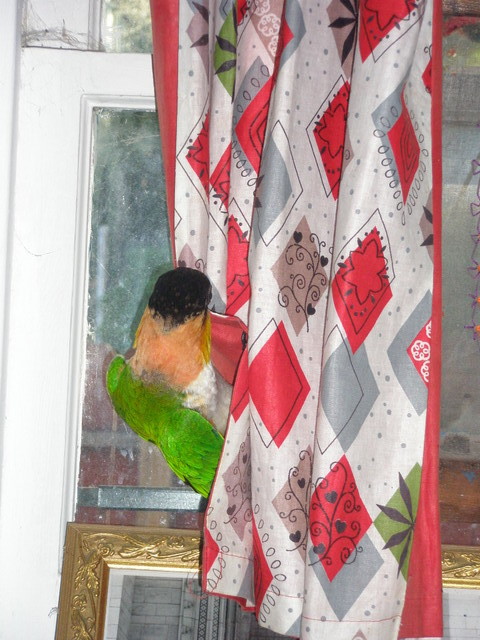
Talullah, climbing the curtains.
Not that we don’t love all parrots, after all- they are all amazing. But I have a soft gushy place in my heart for Caiques. I have two Caiques, named Tengu and Tallulah (aka “Goo and Loo” or “T and T (dyno-mite!)”).

Loo is daintily perched on the rim, while Goo is full on IN the popcorn.
Caiques (pronounced “ky-eeks”) are two species of small, brightly colored parrot in the genus “Pionites”.
Origin:
They originate from the area of the Amazon Rainforest of northern Brazil and southern Venezuela, and the Guiana highlands. The Black-Headed Caique (Pionites melanocephala- like Goo and Loo), originates from North of the Amazon and westward to parts of Venezuela, Ecuador and Peru. The White-Bellied Caique's (Pionites leucogaster) habitat is South of the Amazon, from northern Brazil and spreading to parts of Bolivia, Ecuador and Peru.
Appearance:
The Black-Headed Caique (BHC) is slightly smaller than the White-Bellied Caique (WBC), with mature lengths of 23-25cm and weights of approximately 150g and 170g respectively. Caiques are also occasionally known as the “Seven Color Parrot” because of their many feather colors. (Black, Green, Yellow, Orange, White and Blue hued feathers have all been observed.)
White Bellied Caiques (WBC):
All WBC are Pionites leucogaster. From there they are broken down into three subspecies.
WBC, Green-thighed: Pionites leucogaster leucogaster.
WBC, Yellow-thighed: Pionites leucogaster xanthomeria.
WBC, Yellow-tailed: Pionites leucogaster xanthurus.
Black Headed Caique (BHC):
Both Black-headed caiques are Pionites melanocephala. From there they are broken down into two subspecies.
Black-headed (the BHC we have in the U.S.): melanocephala with the full scientific name being Pionites melanocephala melanocephala.
Pallid: pallida with the full scientific name being Pionites melanocephala pallida.
Personality:
If you want a bird that will sit contentedly on a perch, then a Caique is not for you. No matter how may toys you have on or near the perch, there are other, more exciting things to explore. This wonderful little bird that is known as ‘the clown of the parrot world’. They are stubborn, fearless, good with strange situations, acrobatic, affectionate, and have a great sense of humor.

Swinging and screaming, two things at which Caiques excel.
While most sites will tell you that there is little difference in personality between the two species, I have observed that WBCs are a bit more mellow than their BHC counterparts. This is anecdotal of course, but it is a belief based on observation of dozens of each subspecies. Which to choose is often decided by price and availability- as they are rarer than other parrots to obtain. Typically WBC are more expensive than the BHC, because the latter is more common. Prices can range from $600 to $1500, depending on source and area of the country so it is best to shop around. Pet stores usually are on the high end of the price scale.
Diet:
In the wild, Caiques generally prefer forested areas as habitat and subsist on fruit and seeds. They have no special dietary requirements; pellets supplemented with fruits, vegetables and other foods common to parrots will satisfy their needs and requirements. Some breeders are known to supplement their diet with lory nectar. They do have a fondness for chewing natural green branches, so providing a supply of these is recommended.
My birds LOVE Momma's Birdie Bread. I make it in mini muffins and freeze them, so that they have a steady supply. Their favorite flavor is Harvest Loaf, followed by Caribbean Loaf. But they have had every flavor and eat the muffins enthusiastically!
Care:
They aren’t very big birds, but they will use every square inch of their cage, so that I would recommend no smaller than a 24 x 24 x 18 inch cage- and that is a bit on the small side. My girls share a 36” x 25”. Be sure barspacing is no wider than 5/8”.
They play rough, and will play with toys that most people would reserve for larger birds such as Amazons. They are not afraid of anything, and during their time out of the cage, they should be watched closely so they don’t get themselves in trouble. Because they do love trouble- many people name their Caiques accordingly- I have met Caiques named Loki, Bandit, Outlaw, and of course, Tengu!
Behavior/Quirks:
They can be headstrong, so consistent discipline is a must from the start. Decide what is and is not acceptable behavior, and stick to it. They tend to use their beaks on fingers as well as toys. It is not meanness, but just excess energy and curiosity. To discourage beaking of your body parts, keep some toys handy and substitute the toy for your fingers. If the bird insists on chewing on you rather than a toy, some cage time may be appropriate (a “time out”).
They are also rather food aggressive, and if you train them that you should be able to touch them while eating from the beginning, it will serve you well in time.

Tengu, loving on mama and Talullah, gunning for the camera. She wants to eat it one day.
Other behavior issues may include screaming for attention. This may happen in the morning when they are waiting for food (one of a Caique’s favorite things- they eat and play constantly) or when their favorite person leaves the room. The good news is that a Caique does not approach near the volume of larger parrots such as Cockatoos and Macaws. And they don’t actually “scream” as much as beep and whistle- but it is shrill.
This call is s a high pitched, single note call which they repeat at intervals. It does drive some people crazy. Caiques can learn to talk, so if you can teach your bird to “call” you with words rather than yells, so much the better. Caiques are highly intelligent and will soon figure out what you approve and disapprove of if you are consistent in your reactions. Please note: not all Caiques talk well, and if that is important to you, another species is a better choice.
While playing with their favorite human, they may engage in an activity known as “hair surfing”. To do this, they grab a footful of hair and begin swinging back and forth and rubbing their breast on the hair and head of the chosen person. No one knows quite why they do this (many have speculated that it is displaced leaf bathing behavior, as they tend to do it most often after bathing), but they love it, and the only possible problem with it is that they could become a bit tangled up, so be careful of this. You haven’t lived until you’ve had four baby Caiques all hair surfing on you at the same time.
Sally Blanchard, parrot behaviorist, talks about Spikey Le Bec, her famous Caique: “Spike is also clever — very clever. Sometimes too clever for me. If there is mischief, he will find it. If there is a way out of his cage, no matter how hard he has to work, he will find his way out. He is not the type of bird who can be trusted to stay alive out of his cage without close supervision. He has learned several tricks in less time than it takes me to think of them. …About the hair-surfing thing, this IS his obsession. …The record (is) 45 minutes although a few (other) people (have) come close….
Spike is exceptional in crowds of people. He is fearless (except for balloons which terrify him!) and will generally go to and be delightfully tame to almost anyone. Sometimes it even surprises me because he can be a real butt around his cage at home — especially if he is involved with a favorite food. Spike and the other Caiques I know are real gluttons when it comes to food. They love to eat almost anything and become very possessive about their favorite foods. Like most narcissists, Spike is not into sharing. I think the only food he has ever rejected was a small piece of smoked oyster. Since that shouldn’t be a part of his diet, it didn’t matter anyway….Would I recommend a Caique as a pet for everyone? — Absolutely not! Would I recommend one to a knowledgeable bird owner willing and able to do “the right thing” for their avian companion — absolutely!”

Talullah, climbing the curtains.
Further Resources:
Slideshow of caique egg to adult
Companion Parrot Online (home to Sally Blanchard and Spikey LeBec)
Now through 10/4, use the code ilovecaiques to get 20% off your order over $75!
Slideshow of caique egg to adult
Companion Parrot Online (home to Sally Blanchard and Spikey LeBec)
Now through 10/4, use the code ilovecaiques to get 20% off your order over $75!
Tuesday, September 20, 2011
Birdie Recipe: 7-layer Salad
A bird cannot survive by birdie bread alone! While birdie bread is a healthy food most days, variety is the key to a healthy diet. Here is a trick to help feed an assortment of fruits and vegetables to your bird(s) without being a slave to the chopping block.
Most people know that parrots need to eat fresh healthy foods as a staple in their diet, but if you a have a few larger birds or a larger sized flock prepping all that food everyday can be really time consuming. A solution? Make this 7 layer salad once a week! You can alternate different ingredients for the layers based on what’s in season, and it keeps in the fridge for a week!
Layer 1 (bottom layer) - chopped greens, which are varied each week. One week, I’ll use collard greens and parsley and mustard greens, and the next I might use Swiss chard, kale and dandelion greens.
Layer 2 - chopped (1/4 to 1/2 inch cubes) green vegetables, including any of the following: Brussels sprouts, zucchini and other summer squash, jicama, red or green peppers, fresh hot peppers, chayote squash, green beans, fresh peas, cucumber, celery, anise root, etc.
Layer 3 - chopped broccoli and shredded carrots
Layer 4 - dry, uncooked pasta. This will absorb some of the moisture from the mix and soften nicely.
Layer 5 - cooked beans. I usually buy one of the 13 or 17 bean soup mixes, which I soak overnight, rinse, and then bring to a boil and cook for about 25 minutes, then drain. Alternately, you could use cans of beans (which are already cooked).
Layer 6 - a mixture of chopped apples, oranges and whole grapes
Layer 7 - frozen mixed vegetables.
The containers are then placed in the refrigerator (don’t freeze).
Issues of freshness: this mix stays fresh in these tubs for up to seven days for three reasons. First, layered salads stay fresher longer. Second, the orange juice filters down and slightly acidifies that mix. The frozen mixed vegetables placed on top super-cool the mix immediately (cold air sinks/warm air rises).
I do also wash all the fruits, vegetables and greens with Oxy-fresh Cleansing Gel or produce wash, which not only gets them clean but also has some anti-bacteria action.
Note: If you have a plucker in your flock, eliminate the bean layer. Beans are high in niacin, which aggravates plucking. Pluckers should also have no corn or soy.
Now through Sept 27, enter code eatyourgreens and get a free bag of birdie bread when you order three!
Most people know that parrots need to eat fresh healthy foods as a staple in their diet, but if you a have a few larger birds or a larger sized flock prepping all that food everyday can be really time consuming. A solution? Make this 7 layer salad once a week! You can alternate different ingredients for the layers based on what’s in season, and it keeps in the fridge for a week!
![]() |
| Kale |
Layer 2 - chopped (1/4 to 1/2 inch cubes) green vegetables, including any of the following: Brussels sprouts, zucchini and other summer squash, jicama, red or green peppers, fresh hot peppers, chayote squash, green beans, fresh peas, cucumber, celery, anise root, etc.
Layer 3 - chopped broccoli and shredded carrots
Layer 4 - dry, uncooked pasta. This will absorb some of the moisture from the mix and soften nicely.
![]() |
| Legumes. |
Layer 6 - a mixture of chopped apples, oranges and whole grapes
Layer 7 - frozen mixed vegetables.
The containers are then placed in the refrigerator (don’t freeze).
Issues of freshness: this mix stays fresh in these tubs for up to seven days for three reasons. First, layered salads stay fresher longer. Second, the orange juice filters down and slightly acidifies that mix. The frozen mixed vegetables placed on top super-cool the mix immediately (cold air sinks/warm air rises).
I do also wash all the fruits, vegetables and greens with Oxy-fresh Cleansing Gel or produce wash, which not only gets them clean but also has some anti-bacteria action.
Note: If you have a plucker in your flock, eliminate the bean layer. Beans are high in niacin, which aggravates plucking. Pluckers should also have no corn or soy.
Now through Sept 27, enter code eatyourgreens and get a free bag of birdie bread when you order three!
Tuesday, September 13, 2011
Bird Safe House Plants
For homes where birds and plants are to coexist, knowing which plants are considered bird safe is a must. The Shopper’s Guide to Bird-Safe House Plants provides a bird owner with a quick, easy-to-use, resource for selecting such plants.
Each of the house plants listed in this guide have been compiled from numerous bird related sources, include Bird Talk Magazine, the Complete Bird Owner’s Handbook by Gary Gallerstein, D.V.M., Feeding Your Pet Bird by Barron’s, as well as informational sheets from various bird clubs and organizations.
Before you purchase a house plant, see if the plant’s botanical name is listed in either section of this guide.
Section 1:
Bird-Safe Plants by Common Name
In this section, house plants considered bird-safe are listed alphabetically by some of their more popular common names. The botanical names for these plants are listed next to them in italics. In general, common names are those everyday words someone has used to describe a plant, such as “Painted Fingernail,” or “Rabbit’s Foot Fern.” Since many different plants us the same or a similar common name, make sure the botanical name matches the plant being considered. If you do not find the common name listed, be sure and check the listing of botanical names in section two. Note: If a plant’s does not list its botanical name, as a qualified sales person for the name, or consider another plant.
Section 2:
Bird-Safe Plants by Botanical Name
In this section, plants are listed alphabetically by their botanical name. Botanical names ending with the word “species” represent all plants that begin with the first word of that botanical name. For example, Peperomia argyreia and Peperomia caperata, two different plants, would be represented by the single listing Peperomia species.
If a plant’s botanical name is not found, it’s best to choose another plant. Only those plants listed as bird safe in this guide’s source material were included.
Other considerations:
1. Some plants have sharp or potentially injurious parts. Evaluate such plants for their suitability.
2. VERY IMPORTANT! Be sure the plant you purchase is free from pesticides. Pet birds are more likely to die from pesticide poisoning than from a plant believed to be harmful.
3. Unless a plant is part of a dietary supplement, or known to be safe by you, avoid letting your bird(s) eat or nibble it, particularly if it’s new to their diet. Be extra safe even on plants considered bird safe.
4. Some plants reported as bird-safe, such as Pothos, have also been reported as unsafe in other listings. These plants have been noted by placing (h) after names to indicate they may or may not be harmful to pet birds.
Bird-Safe Plants by Common Names
Botanical Names follow; (h) = may or may not be harmful
A
Acacia Acacie baileyana
Action Plant Mimosa pudica
African Violets Saintpaulia ionantha
Airplane Plant Chlorophytum comosum
Aloe Aloe Species (h)
Aluminum Plant Pilea cadierei
American Rubber Plant Peperomia obtusifolia
Angel’s Tears Soleirolia soleeirolii
Antelope Ears Platycerium bifurcatum
Arabian Coffee Tree Coffea Arabica (Beans Toxic)
Areca Palm Chrysalidocarpus lutescens
Acrum Ivy Epipremnum aureum (h)
Asparagus Fern Asparagus densiflorus
Aspidistra Aspidistre elatior
Assam Rubber Plant Ficus elastica
Aster Aster novi-belgii
Australian Ivy Palm Brassaia actinophlla (h)
Australian Ivy Palm Schefflera actinophylla (h)
Austalian Pine Araucaria excelsa, A. heterophylla
Australian Umbrella Tree Brassaie actinophylla (h)
Australian Umbrella Tree Schefflera actinophylla (h)
B
Baby Jade Crassula argentea
Baby Rubber Plant Peperomia obtusifolia
Baby’s Breath Gypsophila paniculata
Baby’s Tears Helxine soleirolii
Baby’s Tears Soleirolia soleirolii
Bachelor’s Button Centaurea cyanus
Ball Fern Davellia mariesii
Bamboo Arundinaria species
Bamboo Bamusa species
Bamboo Phyllostachys aurea
Bamboo Palm Rhapis excelsa
Barroom Plant Aspidistra elatior
Begonia Begonia species
Belgian Evergreen Dracaena sanderana (h)
Belmore Sentry Palm Howea belmoreana
Benjamin Tree Ficus benjamina
Billbergia Billergia species
Birds’s Nest Fern Asplenium nidus
Blacking Plant Hibiscus rosa-sinensis
Bloodleaf Plant Iresine herbstil
Bluebottle Centaurea cycnus
Blushing Bromeliad Neoregelia carolinea
Blushing Cup Nidularium fulgens
Boston Fern Nephrolepis exaltata
Bottle Palm Beaucamea recurvata
Bougainvillea Bougainvilla glabra
Braided Ficus Ficus elastica
Brake Fern Pteris cretica
Broad-leaved Lady Palm Rhapis excelsa
Bromelia Bromelia species
Bromeliad Aechmea species, Vriesea species
Broom Cytisus species
Burro’s Tail Sedum morganianum
Butterfly Palm Chrysalidocarpus lutescens
Button Fern Pellaea rotundifolia
C
Cabbage Tree Cordyline terminalis
Calathea Calathea zebrine
California Maidenhair Adiantum jordanii
Camellia Camellia japonica
Canary Island Date Palm Phoenix canariensis
Candle Plant Plectranthus coleoides
Cane Palm Chrysalidocarpus lutescens
Cape Jasmine Gardenia jasminoides
Cast Iron Plant Aspidistra elatior
Cauliflower Ears Crassula argentea
Chickweed Cerastium vulgatum
China Rose Hibiscus rosa-sinensis
Chinese Fan Palm Livestona chinensis
Chinese Fountain Pa lm Livestona chinensis
Chinese Hibiscus Hibiscus rosa-sinensis
Chinese Rubber Plant Crassula argentea
Christmas Cactus Schlumbergera bridesii
Christmas Cactus Zygocactus truncates
Cissus Cissus antarctica
Climbing Rose Rosa species
Coffee or Coffee Plant Coffea Arabica (Beans Toxic)
Coleus Coleus species
Common Houseleek Sempervivum tectorum
Common Zinna Zinnea elegans
Coral Berry Aechmea fulgens “Discolor”
Corn Plant Dracaena Fragans massangeana
Cornflower Centaurea cycnus
Cosmos Cosmos bipinnatus
Crab Cactus Zygocactus truncates
Crassula argentea Crassula argentea
Creeping Charlie Pilea nummulariifolia
Creeping Fig Ficus pumila
Creeping Fig Ficus repens
Cretan Brake Fern Pteris cretica
Cryptanthus Cryptanthus species
Curly Palm Howea belmoreana
D
Dagger Plant Yucca alofolia
Dahlia Dahlia species
Deer’s Foot Fern Davallia canariensis
Delta Maidenhair Fern Adiantum raddianum
Devil’s Ivy Epipremnum aureum (h)
Dish Fern Pteris cretica
Dogwood Cornus species
Dollar Plant Crassula argentea
Donkey Tail Sedum morganianum
Dracaena Cordyline terminalis (h)
Dracaeana Dracaeana species (h)
Dragon Tree Dracaena draco
Dudder Grass Adiantum capillus-ceneris
Dutchwings Gasteria lilputana
Dwarf Fan Palm Rhapis excelsa
Dwarf Rubber Plant Crassula argentea
Dyckia Dychia fosterana
E
Earth Stars Cryptanthus species
Easter Cactus Rhipsalidopsis gaerineri
Echeveria Echeveria elegans
Edible Fig Ficus carica
Alephant_Foot Tree Beaucarnea recurvata
Elk’s Horn Fern Platycerium bifurcatum
Emerald Feather Asparagus densiflorus
Emerald Fern Asparagus densiflorus
Emerald Ripple Peperomia caperata
European Fan Palm Chamaerops humilis
F
False Aralia Dizgotheca elegantissima
Fan Palm Trachycarpus fortunei
Fatsia Fatsia japonica
Fern Rhapis Rhapis excelsa
Fiddle-leaf Fig Ficus lyrate (h)
Fiddleleaf Fig Ficus pandurata (h)
Fig Ficus benjamina
Fiji Fern Davallia canariensis
Fish Tail Fern Cyrtomium falcatum
Fishtail Palm Caryota mitis (Fruit toxic)
Fittonia Fittonia verschaffeltii
Five-finger Fern Adiantum alaleuticum
Flaming Katy Kalanchoe blossfeldiana: Kalanchoe spp. (h)
Flaming Sword Vriesea splendens
Flamingo Plant Hypoestes phyllostachya
Flat Palm Howea forsterana
Formosa Rice Tree Fatsia japonica
Forster Sentry Palm Howea forsterana
Forsythia Forsythia species
Freckle Face Hypoestes phyllostachya
Freckle Face Hypoestes sanguinolenta
Friendship Plant Billbergie nutans
Fucsha Fuschia species
Funeral Palm Cycas revolute (h)
G
Gardenia Gardenia jasminoides
Gasteria Gasteria species
Giant Inch Plant Tradescantia albiflora
Giant Yucca Yucca elephantipes
Glossy-Leaved Paper Plant Fatsia japonica
Gold Dust Dracaena godseffiana
Golden Bells Forsythia species
Golden Butterfly Palm Chrysalidocarpus lutescens
Golden Ceylon Creeper Epipremnum aureum (h)
Golden Feather Palm Chrysalidocarpus lutescens
Golden Polypodium Polypodium aureum
Golden Pothos Epipremnum aureum (h)
Goldfish Plant Columnea hirta
Good Luck Plant Cordyline terminalis
Grape Ivy Cissus rhombifolia
Grape Ivy Rhoicissus rhomboidea
Grecian Laurel Laurus noblis
Green Ripple Peperomia Peperomia caperata
Guava Pineapple Feijoa sellowiana
Guzmania Guzmania lingulata
Gypsophila Gypsophila paniculata
H
Hare’s Foot Fern Phlebodium aureum
Hare’s Foot Fern Polypodium aureum
Hawaiian Good Luck Plant Cordyline terminalis
Hawaiian Hibiscus Hibiscus rosa-sinensis
Hawaiian Tree Fern Cibotium chamissoi
Heart of Flame Bromelia balansae
Hens and Chickens Echeveria elegans
Hens and Chickens Sempervivum tectorum
Hens and Chicks Echeveria elegans
Hens and Chicks Echeveria runyonii
Hibiscus Hibiscus rosa-sinensis
Holly Fern Cyrtomium falcatum
Honey Plant Hoya camosa: Hoya spp. (h)
House Pine Araucaria excelsa, A. heterophylla
Howea Palm Howea species
Humble Plant Mimosa pudica
Hunter’s Robe Epipremnum aurreum (h)
I
Inch Plant Tradescantia albiflora
India Rubber tree Ficus elastica
Irish Moss Helxine soleirolii
Irish Moss Soleirolia soleirolia
Iron Fern Rumohra adiantiformis
Ivy-leaf Pepper Peperomia griseoargentea
J
Jade Plant Crassula argentea
Jade Plant Crassula arborescens
Jade Plant Crassula cotyledon
Jade Plant Crassula pertulacea
Jade Tree Crassula argentea
Japanese Aralia Fatsia japonica
Japanese Aralia Aralia japonica
Japanese Aralia Aralia sieboldii
Japanese Camellia Camellia japonica
Japanese Fatsia Fatsia japonica
Japanese Fern Palm Cycas revolute (h)
Japanese Holly Fern Cyrtomium falcatum
Japanese Rubber Plant Crassula argentea
Japanese Sago Palm Cycas revolute (h)
Japanese Skimma Skimmia japonica (h)
Java Fig Ficus benjamina
K
Kalanchoe Kalanchoe blossfeldiana; Kalanchoe spp. (h)
Kangaroo vine Cissus antarctia
Kentia Palm Howea species
L
Lace Trumpet Sarracenia Leucophylla
Lady Palm Rhapis excelsa
Lady’s Eardrops Fucshia species
Laurel Leaf Fig Ficus lyrata (h)
Leather Fern Rumohra adiantiformis
Leatherleaf Fern Rumohra adiantiformis
Lipstick Plant Aeschynanthus radicans
Little Fantasy Peperomia Peperomia caperata
Live and Die Plant Mimosa pudica
Living Vase Plant Aechmea species
Lomaria Blechnum gibbum
M
Madagascar Palm Chrysalidocarpus lutescens
Magnolia Magnolia species
Maidenhair Fern Adiantum species
Mango Mangifera indica (fruit only)
Marigold Tegetes species
Massange’s Arrowroot Maranta leuconeura (h)
Massange’s Dracaena Fragrans massangeana
Measles Plant Hypoestes phyllostachya
Mediterranean Fan Palm Chamaerops humilis
Mexican Bottle Plant Beaucamea recurvata
Mexican Gem Echeveria elegans
Mexican snowball Echeveria elegans
Mexican Tree Fern Cibotium schiedei
Michaelmas Daisy Aster novi-belgoo
Miniature Date Palm Phoenix roebelenii
Miniature Fan Palm Rhapis excelsa
Miniature Jasmine Gardenia jasminoides
Monkey Plant Ruellia makoyana
Mosaic Plant Fittonia verschaffeltii
Mother In Law’s Tongue Sansevievia trifasciate
Mother Fern Asplenium bulbiferum
N
Nasturtium Tropaeolum majus
Natal Plum Carissa grandiflora (Fruit only)
Natal Plum Carissa macrocarpa (Fruit only)
Neanthe Bella Palm Chamaedorea elegans
Neoregelia Neoreglia species
Nerve Plant Fittonia verschanffeltii
Nest Fern Asplenium nidus
New York Aster Aster novi-belgii
Nidularium Nidularium billbergoides
Norfolk Island Pine Araucaria excelsa, A. heterphylla
O
Octopus Tree Brassaia actinophylla (h)
Octopus Tree Schefflera actinophylla (h)
Old Man and woman Sempervivum tectorum
Olive Olea europaea
Oriental Bamboo Bambusa glaucescens
Ornamental Dracaena Cordyline terminalis
P
Painted Fingernail Neoregelia species
Painted Nettle Coleus species
Paper Flower Bougainvillea glabra
Paper Plant Fatsia japonica
Parlor Palm Chamaedorea elegans
Passion Flower Passiflora species
Pearl Echeveria Echeveria elegans
Pellaea Pellaea rotundifolia
Pepperomia Peperomia obtusifolia
Petunia Petunia species
Phlox Phlox species
Piggyback Plant Tolmiea menziesii
Pineapple Ananas comosus
Pink Polka Dot Plant ]Hypoestes phyllostachya
Pitcher Plant Sarracenia leucophylla
Pittosporum Pittosporum species (h)
Platinum Pepper Peperomia griseoargentea
Pleomele Dracaena reflexa
Pleomele Plemele reflexa
Polka Dot Plant Hypoestes phyllostachya
Polypody Polypodium aureum
Ponytail Palm Beaucarnea recurvata
Pothos Epipremnum aureum (h)
Pothos Vine Maranta leuconeura (h)
Prayer Plant Matanta leuconeura (h)
Prostrate Coleus Plectrenthus oetendahlii
Purple Nettle Gynura aurantiaca
Purple Passion Gynura aurantiaca
Purple Velvet Plkant Gynura aurantiaca
Pygmy Date Palm Phoenix roebelenii
Q
Queen’s Tears Billbergia nutans
Queen’s Umbrella Tree Brassaia actinophylla (h)
Queen’s Umbrella Tree Schefflera actinophylla (h)
Queensland Umbrella Tree Brassaia actinophylla (h)
Queensland Umbrella Tree Schefflera actinophylla (h)
R
Rabbit’s Foot Fern Davallia fejeensis
Rabbit’s Foot Fern Polypodium aureum
Rabbit’s Tracks Plant Maranta leuconeura (h)
Radiator Plant Peperomia grisoargentea
Rainbow Star Cryptanthus bromeliodes
Raphidophora Epipremnum aureum (h)
Red Margined Dracaena Dracaena marginata
Red Creeping Charlie Plectranthis oertendahlii
Ribbon and Bows Chlorophytum comosum
Ribbon Fern Pteris cretica
Ribbon Plant Chlorophytum comosum
Ribbon Plant Dracaena sanderana (h)
Roebelin Palm Phoenix roebelenii
Roof Houseleek Sempervivum tectorum
Rose Rosa species
Rose of China Hibiscus rosa-sinensis
Rosy Maidenhair Adiantum hispidulum
Roundleaf Fern Pellaea rotundifolia
Royal Velvet Plant Gynura aurantiaca
Rubber Plant Ficus elastica
S
Saffron Spike Aphelandra squarrosa
Sago Palm Cycas revolute (h)
Scabiosa Scabiosa caucasica
Schefflera Brassaia actinophylla (h)
Schefflera Schefflera actinophylla (h)
Screw Pine Pandanus veitchii
Sedum Sedum morganianum
Sensitive Plant Mimosa pudica
Sentry Palm Howea species
Shame Plant Mimosa pudica
Silver Dollar Maidenhair Adiantum peruvianum
Silver Fittonia Fittonia verschaffeltii
Silver Nerve Fittonia verschaffeltii
Silver Net Plant Fittonia verschaffeltii
Silver Threads Fittonia verschaffeltii
Skimmia Skimmia species (h)
Slender Lady Palm Rhapis humillis
Small leaved Rubber Plant Ficus benjamina
Snake Plant Sansevieria trifasciata
Snapdragon Antirrhinum majus
Solomon Island Ivy Epipremnum aureum (h)
Southern Maidenhair Fern Adiantum capillus-veneris
Southern Maidenhair Fern Adiantum raddianum
Southern Sword Fern Nephrolepis cordifolia
Spanish Bayonet Yucca aloifolia
Spider Fern Chlorophytum comosum
Spider Plant Chlorophytum comosum
Spineless Yucca Yucca elephantipes
Spotted Sasteria Gasteria maculate
Sprenger Asparagus Asparagus densiflorus
Sprengeri Fern Asparagus densiflorus
Spur Flower Plectranthus australis
Squirrel’s Foot Fern Davallia trichomanoides
Staghorn Fern Platycerium bifurcatum
Starfish Plant Cryptanthus acaulis
Starleaf Brassaia actinophylla (h)
Starleaf Schefflera actinophylla (h)
Swedish Begonia Plectranthus australis
Swedish Ivy Plectranthus australis
Sweet Bay Laurus nobilis
Sword Fern Nephrolepis exaltata
T
Table Fern Pteris cretica
Taro Vine Epepremnum aureum (h)
Ten Commandments Maranta leuconeura( h)
Thanksgiving Cactus Schlumbergera truncate
Thanksgiving Cactus Zygocactus truncactus
Thatch Leaf Palm Howea forsterana
Thousand Mothers Tolmiea menziesii
Thyme Thymus vulgare
Ti Log Cordyline terminalis
Ti Plant Cordyline terminalis
Tillandsia Tillandsia cyanea
Tom Thumb Kalanchoe clossfeldiana
Touch Me Not Mimosa pudica
Trailing Watermelon Begonia Pelloinia daveauana
Tree of Kings Cordlyline Terminalis
Tree Fern Cibotium species
Tropical Hibiscus Hibiscus rosa-sinensis
U
Umbrella Tree Brassaia actinophlla (h)
Umbrella Tree Schefflera actinophylla (h)
Urn Plant Aechmea fasciata
V
Variegated Philodendron Epipremnum aureum (h)
Variegated Wandering Jew Tradescantia fluminensis
Vase Plant Billbergia species
Vase Plant Vriesea species
Velvet Nettle Gynura aurantiaca
Velvet Plant Gynura aurantiaca
Venezuela Treebine Cissus rhomifolia
Venus’s Hair Adiantum capillus-veneris
Volcano Plant Bromelia Balansae
Vriesea Vriesea species
W
Walking Anthericum Chlorophytum comosum
Wandering Jew Tradescantie albiflora
Wandering Jew Tradescantie fluminensis
Wandering Jew Zebrina pendula
Warneckii Dracaena Dracaena deremensis
Watermelon Begonia Peperomia argyreia
Watermelon Peperomia Peperomia argyreia
Watermelon Pilea Pilea cadierei
Wax Plant, or flower Hoya carnosa
Weeping Chinese Banyon Ficus benjamina
Weeping Fig Ficus benjamina
Western Maidenhair Fern Adiantum aleuticum
White Least Fittonia Fittonia verschaffeltii
White Mexican Rose Echeveria elegans
Windmill Palm Chamaerops excelsa
Windmill Palm Trachycarpus fortunei
Wine Palm Caryota urens (toxic fruit)
Y
Yellow Bamboo Phyllostachys aurea
Youth on Age Tolmiea menziesii
Youth and Old Age Zinnea elegans
Yucca Yucca aloifolia, Y. lephantipes
Z
Zebra Plant Aphelandra squarrosa
Zebra Plant Calathea zebrine
Zebra Plant Cryptanthus zonatus
Zinnia Zinnea elegans
Bird Safe Plants by Botanical Name
Each of the house plants listed in this guide have been compiled from numerous bird related sources, include Bird Talk Magazine, the Complete Bird Owner’s Handbook by Gary Gallerstein, D.V.M., Feeding Your Pet Bird by Barron’s, as well as informational sheets from various bird clubs and organizations.
Now through 9/20, use code birdsafehouseplants and get
free shipping on orders of $100 or more!
Using this Guide
Before you purchase a house plant, see if the plant’s botanical name is listed in either section of this guide.
Section 1:
Bird-Safe Plants by Common Name
In this section, house plants considered bird-safe are listed alphabetically by some of their more popular common names. The botanical names for these plants are listed next to them in italics. In general, common names are those everyday words someone has used to describe a plant, such as “Painted Fingernail,” or “Rabbit’s Foot Fern.” Since many different plants us the same or a similar common name, make sure the botanical name matches the plant being considered. If you do not find the common name listed, be sure and check the listing of botanical names in section two. Note: If a plant’s does not list its botanical name, as a qualified sales person for the name, or consider another plant.
Section 2:
Bird-Safe Plants by Botanical Name
In this section, plants are listed alphabetically by their botanical name. Botanical names ending with the word “species” represent all plants that begin with the first word of that botanical name. For example, Peperomia argyreia and Peperomia caperata, two different plants, would be represented by the single listing Peperomia species.
If a plant’s botanical name is not found, it’s best to choose another plant. Only those plants listed as bird safe in this guide’s source material were included.
Other considerations:
1. Some plants have sharp or potentially injurious parts. Evaluate such plants for their suitability.
2. VERY IMPORTANT! Be sure the plant you purchase is free from pesticides. Pet birds are more likely to die from pesticide poisoning than from a plant believed to be harmful.
3. Unless a plant is part of a dietary supplement, or known to be safe by you, avoid letting your bird(s) eat or nibble it, particularly if it’s new to their diet. Be extra safe even on plants considered bird safe.
4. Some plants reported as bird-safe, such as Pothos, have also been reported as unsafe in other listings. These plants have been noted by placing (h) after names to indicate they may or may not be harmful to pet birds.
Bird-Safe Plants by Common Names
Botanical Names follow; (h) = may or may not be harmful
A
Acacia Acacie baileyana
Action Plant Mimosa pudica
African Violets Saintpaulia ionantha
Airplane Plant Chlorophytum comosum
Aloe Aloe Species (h)
Aluminum Plant Pilea cadierei
American Rubber Plant Peperomia obtusifolia
Angel’s Tears Soleirolia soleeirolii
Antelope Ears Platycerium bifurcatum
Arabian Coffee Tree Coffea Arabica (Beans Toxic)
Areca Palm Chrysalidocarpus lutescens
Acrum Ivy Epipremnum aureum (h)
Asparagus Fern Asparagus densiflorus
Aspidistra Aspidistre elatior
Assam Rubber Plant Ficus elastica
Aster Aster novi-belgii
Australian Ivy Palm Brassaia actinophlla (h)
Australian Ivy Palm Schefflera actinophylla (h)
Austalian Pine Araucaria excelsa, A. heterophylla
Australian Umbrella Tree Brassaie actinophylla (h)
Australian Umbrella Tree Schefflera actinophylla (h)
B
Baby Jade Crassula argentea
Baby Rubber Plant Peperomia obtusifolia
Baby’s Breath Gypsophila paniculata
Baby’s Tears Helxine soleirolii
Baby’s Tears Soleirolia soleirolii
Bachelor’s Button Centaurea cyanus
Ball Fern Davellia mariesii
Bamboo Arundinaria species
Bamboo Bamusa species
Bamboo Phyllostachys aurea
Bamboo Palm Rhapis excelsa
Barroom Plant Aspidistra elatior
Begonia Begonia species
Belgian Evergreen Dracaena sanderana (h)
Belmore Sentry Palm Howea belmoreana
Benjamin Tree Ficus benjamina
Billbergia Billergia species
Birds’s Nest Fern Asplenium nidus
Blacking Plant Hibiscus rosa-sinensis
Bloodleaf Plant Iresine herbstil
Bluebottle Centaurea cycnus
Blushing Bromeliad Neoregelia carolinea
Blushing Cup Nidularium fulgens
Boston Fern Nephrolepis exaltata
Bottle Palm Beaucamea recurvata
Bougainvillea Bougainvilla glabra
Braided Ficus Ficus elastica
Brake Fern Pteris cretica
Broad-leaved Lady Palm Rhapis excelsa
Bromelia Bromelia species
Bromeliad Aechmea species, Vriesea species
Broom Cytisus species
Burro’s Tail Sedum morganianum
Butterfly Palm Chrysalidocarpus lutescens
Button Fern Pellaea rotundifolia
C
Cabbage Tree Cordyline terminalis
Calathea Calathea zebrine
California Maidenhair Adiantum jordanii
Camellia Camellia japonica
Canary Island Date Palm Phoenix canariensis
Candle Plant Plectranthus coleoides
Cane Palm Chrysalidocarpus lutescens
Cape Jasmine Gardenia jasminoides
Cast Iron Plant Aspidistra elatior
Cauliflower Ears Crassula argentea
Chickweed Cerastium vulgatum
China Rose Hibiscus rosa-sinensis
Chinese Fan Palm Livestona chinensis
Chinese Fountain Pa lm Livestona chinensis
Chinese Hibiscus Hibiscus rosa-sinensis
Chinese Rubber Plant Crassula argentea
Christmas Cactus Schlumbergera bridesii
Christmas Cactus Zygocactus truncates
Cissus Cissus antarctica
Climbing Rose Rosa species
Coffee or Coffee Plant Coffea Arabica (Beans Toxic)
Coleus Coleus species
Common Houseleek Sempervivum tectorum
Common Zinna Zinnea elegans
Coral Berry Aechmea fulgens “Discolor”
Corn Plant Dracaena Fragans massangeana
Cornflower Centaurea cycnus
Cosmos Cosmos bipinnatus
Crab Cactus Zygocactus truncates
Crassula argentea Crassula argentea
Creeping Charlie Pilea nummulariifolia
Creeping Fig Ficus pumila
Creeping Fig Ficus repens
Cretan Brake Fern Pteris cretica
Cryptanthus Cryptanthus species
Curly Palm Howea belmoreana
D
Dagger Plant Yucca alofolia
Dahlia Dahlia species
Deer’s Foot Fern Davallia canariensis
Delta Maidenhair Fern Adiantum raddianum
Devil’s Ivy Epipremnum aureum (h)
Dish Fern Pteris cretica
Dogwood Cornus species
Dollar Plant Crassula argentea
Donkey Tail Sedum morganianum
Dracaena Cordyline terminalis (h)
Dracaeana Dracaeana species (h)
Dragon Tree Dracaena draco
Dudder Grass Adiantum capillus-ceneris
Dutchwings Gasteria lilputana
Dwarf Fan Palm Rhapis excelsa
Dwarf Rubber Plant Crassula argentea
Dyckia Dychia fosterana
E
Earth Stars Cryptanthus species
Easter Cactus Rhipsalidopsis gaerineri
Echeveria Echeveria elegans
Edible Fig Ficus carica
Alephant_Foot Tree Beaucarnea recurvata
Elk’s Horn Fern Platycerium bifurcatum
Emerald Feather Asparagus densiflorus
Emerald Fern Asparagus densiflorus
Emerald Ripple Peperomia caperata
European Fan Palm Chamaerops humilis
F
False Aralia Dizgotheca elegantissima
Fan Palm Trachycarpus fortunei
Fatsia Fatsia japonica
Fern Rhapis Rhapis excelsa
Fiddle-leaf Fig Ficus lyrate (h)
Fiddleleaf Fig Ficus pandurata (h)
Fig Ficus benjamina
Fiji Fern Davallia canariensis
Fish Tail Fern Cyrtomium falcatum
Fishtail Palm Caryota mitis (Fruit toxic)
Fittonia Fittonia verschaffeltii
Five-finger Fern Adiantum alaleuticum
Flaming Katy Kalanchoe blossfeldiana: Kalanchoe spp. (h)
Flaming Sword Vriesea splendens
Flamingo Plant Hypoestes phyllostachya
Flat Palm Howea forsterana
Formosa Rice Tree Fatsia japonica
Forster Sentry Palm Howea forsterana
Forsythia Forsythia species
Freckle Face Hypoestes phyllostachya
Freckle Face Hypoestes sanguinolenta
Friendship Plant Billbergie nutans
Fucsha Fuschia species
Funeral Palm Cycas revolute (h)
G
Gardenia Gardenia jasminoides
Gasteria Gasteria species
Giant Inch Plant Tradescantia albiflora
Giant Yucca Yucca elephantipes
Glossy-Leaved Paper Plant Fatsia japonica
Gold Dust Dracaena godseffiana
Golden Bells Forsythia species
Golden Butterfly Palm Chrysalidocarpus lutescens
Golden Ceylon Creeper Epipremnum aureum (h)
Golden Feather Palm Chrysalidocarpus lutescens
Golden Polypodium Polypodium aureum
Golden Pothos Epipremnum aureum (h)
Goldfish Plant Columnea hirta
Good Luck Plant Cordyline terminalis
Grape Ivy Cissus rhombifolia
Grape Ivy Rhoicissus rhomboidea
Grecian Laurel Laurus noblis
Green Ripple Peperomia Peperomia caperata
Guava Pineapple Feijoa sellowiana
Guzmania Guzmania lingulata
Gypsophila Gypsophila paniculata
H
Hare’s Foot Fern Phlebodium aureum
Hare’s Foot Fern Polypodium aureum
Hawaiian Good Luck Plant Cordyline terminalis
Hawaiian Hibiscus Hibiscus rosa-sinensis
Hawaiian Tree Fern Cibotium chamissoi
Heart of Flame Bromelia balansae
Hens and Chickens Echeveria elegans
Hens and Chickens Sempervivum tectorum
Hens and Chicks Echeveria elegans
Hens and Chicks Echeveria runyonii
Hibiscus Hibiscus rosa-sinensis
Holly Fern Cyrtomium falcatum
Honey Plant Hoya camosa: Hoya spp. (h)
House Pine Araucaria excelsa, A. heterophylla
Howea Palm Howea species
Humble Plant Mimosa pudica
Hunter’s Robe Epipremnum aurreum (h)
I
Inch Plant Tradescantia albiflora
India Rubber tree Ficus elastica
Irish Moss Helxine soleirolii
Irish Moss Soleirolia soleirolia
Iron Fern Rumohra adiantiformis
Ivy-leaf Pepper Peperomia griseoargentea
J
Jade Plant Crassula argentea
Jade Plant Crassula arborescens
Jade Plant Crassula cotyledon
Jade Plant Crassula pertulacea
Jade Tree Crassula argentea
Japanese Aralia Fatsia japonica
Japanese Aralia Aralia japonica
Japanese Aralia Aralia sieboldii
Japanese Camellia Camellia japonica
Japanese Fatsia Fatsia japonica
Japanese Fern Palm Cycas revolute (h)
Japanese Holly Fern Cyrtomium falcatum
Japanese Rubber Plant Crassula argentea
Japanese Sago Palm Cycas revolute (h)
Japanese Skimma Skimmia japonica (h)
Java Fig Ficus benjamina
K
Kalanchoe Kalanchoe blossfeldiana; Kalanchoe spp. (h)
Kangaroo vine Cissus antarctia
Kentia Palm Howea species
L
Lace Trumpet Sarracenia Leucophylla
Lady Palm Rhapis excelsa
Lady’s Eardrops Fucshia species
Laurel Leaf Fig Ficus lyrata (h)
Leather Fern Rumohra adiantiformis
Leatherleaf Fern Rumohra adiantiformis
Lipstick Plant Aeschynanthus radicans
Little Fantasy Peperomia Peperomia caperata
Live and Die Plant Mimosa pudica
Living Vase Plant Aechmea species
Lomaria Blechnum gibbum
M
Madagascar Palm Chrysalidocarpus lutescens
Magnolia Magnolia species
Maidenhair Fern Adiantum species
Mango Mangifera indica (fruit only)
Marigold Tegetes species
Massange’s Arrowroot Maranta leuconeura (h)
Massange’s Dracaena Fragrans massangeana
Measles Plant Hypoestes phyllostachya
Mediterranean Fan Palm Chamaerops humilis
Mexican Bottle Plant Beaucamea recurvata
Mexican Gem Echeveria elegans
Mexican snowball Echeveria elegans
Mexican Tree Fern Cibotium schiedei
Michaelmas Daisy Aster novi-belgoo
Miniature Date Palm Phoenix roebelenii
Miniature Fan Palm Rhapis excelsa
Miniature Jasmine Gardenia jasminoides
Monkey Plant Ruellia makoyana
Mosaic Plant Fittonia verschaffeltii
Mother In Law’s Tongue Sansevievia trifasciate
Mother Fern Asplenium bulbiferum
N
Nasturtium Tropaeolum majus
Natal Plum Carissa grandiflora (Fruit only)
Natal Plum Carissa macrocarpa (Fruit only)
Neanthe Bella Palm Chamaedorea elegans
Neoregelia Neoreglia species
Nerve Plant Fittonia verschanffeltii
Nest Fern Asplenium nidus
New York Aster Aster novi-belgii
Nidularium Nidularium billbergoides
Norfolk Island Pine Araucaria excelsa, A. heterphylla
O
Octopus Tree Brassaia actinophylla (h)
Octopus Tree Schefflera actinophylla (h)
Old Man and woman Sempervivum tectorum
Olive Olea europaea
Oriental Bamboo Bambusa glaucescens
Ornamental Dracaena Cordyline terminalis
P
Painted Fingernail Neoregelia species
Painted Nettle Coleus species
Paper Flower Bougainvillea glabra
Paper Plant Fatsia japonica
Parlor Palm Chamaedorea elegans
Passion Flower Passiflora species
Pearl Echeveria Echeveria elegans
Pellaea Pellaea rotundifolia
Pepperomia Peperomia obtusifolia
Petunia Petunia species
Phlox Phlox species
Piggyback Plant Tolmiea menziesii
Pineapple Ananas comosus
Pink Polka Dot Plant ]Hypoestes phyllostachya
Pitcher Plant Sarracenia leucophylla
Pittosporum Pittosporum species (h)
Platinum Pepper Peperomia griseoargentea
Pleomele Dracaena reflexa
Pleomele Plemele reflexa
Polka Dot Plant Hypoestes phyllostachya
Polypody Polypodium aureum
Ponytail Palm Beaucarnea recurvata
Pothos Epipremnum aureum (h)
Pothos Vine Maranta leuconeura (h)
Prayer Plant Matanta leuconeura (h)
Prostrate Coleus Plectrenthus oetendahlii
Purple Nettle Gynura aurantiaca
Purple Passion Gynura aurantiaca
Purple Velvet Plkant Gynura aurantiaca
Pygmy Date Palm Phoenix roebelenii
Q
Queen’s Tears Billbergia nutans
Queen’s Umbrella Tree Brassaia actinophylla (h)
Queen’s Umbrella Tree Schefflera actinophylla (h)
Queensland Umbrella Tree Brassaia actinophylla (h)
Queensland Umbrella Tree Schefflera actinophylla (h)
R
Rabbit’s Foot Fern Davallia fejeensis
Rabbit’s Foot Fern Polypodium aureum
Rabbit’s Tracks Plant Maranta leuconeura (h)
Radiator Plant Peperomia grisoargentea
Rainbow Star Cryptanthus bromeliodes
Raphidophora Epipremnum aureum (h)
Red Margined Dracaena Dracaena marginata
Red Creeping Charlie Plectranthis oertendahlii
Ribbon and Bows Chlorophytum comosum
Ribbon Fern Pteris cretica
Ribbon Plant Chlorophytum comosum
Ribbon Plant Dracaena sanderana (h)
Roebelin Palm Phoenix roebelenii
Roof Houseleek Sempervivum tectorum
Rose Rosa species
Rose of China Hibiscus rosa-sinensis
Rosy Maidenhair Adiantum hispidulum
Roundleaf Fern Pellaea rotundifolia
Royal Velvet Plant Gynura aurantiaca
Rubber Plant Ficus elastica
S
Saffron Spike Aphelandra squarrosa
Sago Palm Cycas revolute (h)
Scabiosa Scabiosa caucasica
Schefflera Brassaia actinophylla (h)
Schefflera Schefflera actinophylla (h)
Screw Pine Pandanus veitchii
Sedum Sedum morganianum
Sensitive Plant Mimosa pudica
Sentry Palm Howea species
Shame Plant Mimosa pudica
Silver Dollar Maidenhair Adiantum peruvianum
Silver Fittonia Fittonia verschaffeltii
Silver Nerve Fittonia verschaffeltii
Silver Net Plant Fittonia verschaffeltii
Silver Threads Fittonia verschaffeltii
Skimmia Skimmia species (h)
Slender Lady Palm Rhapis humillis
Small leaved Rubber Plant Ficus benjamina
Snake Plant Sansevieria trifasciata
Snapdragon Antirrhinum majus
Solomon Island Ivy Epipremnum aureum (h)
Southern Maidenhair Fern Adiantum capillus-veneris
Southern Maidenhair Fern Adiantum raddianum
Southern Sword Fern Nephrolepis cordifolia
Spanish Bayonet Yucca aloifolia
Spider Fern Chlorophytum comosum
Spider Plant Chlorophytum comosum
Spineless Yucca Yucca elephantipes
Spotted Sasteria Gasteria maculate
Sprenger Asparagus Asparagus densiflorus
Sprengeri Fern Asparagus densiflorus
Spur Flower Plectranthus australis
Squirrel’s Foot Fern Davallia trichomanoides
Staghorn Fern Platycerium bifurcatum
Starfish Plant Cryptanthus acaulis
Starleaf Brassaia actinophylla (h)
Starleaf Schefflera actinophylla (h)
Swedish Begonia Plectranthus australis
Swedish Ivy Plectranthus australis
Sweet Bay Laurus nobilis
Sword Fern Nephrolepis exaltata
T
Table Fern Pteris cretica
Taro Vine Epepremnum aureum (h)
Ten Commandments Maranta leuconeura( h)
Thanksgiving Cactus Schlumbergera truncate
Thanksgiving Cactus Zygocactus truncactus
Thatch Leaf Palm Howea forsterana
Thousand Mothers Tolmiea menziesii
Thyme Thymus vulgare
Ti Log Cordyline terminalis
Ti Plant Cordyline terminalis
Tillandsia Tillandsia cyanea
Tom Thumb Kalanchoe clossfeldiana
Touch Me Not Mimosa pudica
Trailing Watermelon Begonia Pelloinia daveauana
Tree of Kings Cordlyline Terminalis
Tree Fern Cibotium species
Tropical Hibiscus Hibiscus rosa-sinensis
U
Umbrella Tree Brassaia actinophlla (h)
Umbrella Tree Schefflera actinophylla (h)
Urn Plant Aechmea fasciata
V
Variegated Philodendron Epipremnum aureum (h)
Variegated Wandering Jew Tradescantia fluminensis
Vase Plant Billbergia species
Vase Plant Vriesea species
Velvet Nettle Gynura aurantiaca
Velvet Plant Gynura aurantiaca
Venezuela Treebine Cissus rhomifolia
Venus’s Hair Adiantum capillus-veneris
Volcano Plant Bromelia Balansae
Vriesea Vriesea species
W
Walking Anthericum Chlorophytum comosum
Wandering Jew Tradescantie albiflora
Wandering Jew Tradescantie fluminensis
Wandering Jew Zebrina pendula
Warneckii Dracaena Dracaena deremensis
Watermelon Begonia Peperomia argyreia
Watermelon Peperomia Peperomia argyreia
Watermelon Pilea Pilea cadierei
Wax Plant, or flower Hoya carnosa
Weeping Chinese Banyon Ficus benjamina
Weeping Fig Ficus benjamina
Western Maidenhair Fern Adiantum aleuticum
White Least Fittonia Fittonia verschaffeltii
White Mexican Rose Echeveria elegans
Windmill Palm Chamaerops excelsa
Windmill Palm Trachycarpus fortunei
Wine Palm Caryota urens (toxic fruit)
Y
Yellow Bamboo Phyllostachys aurea
Youth on Age Tolmiea menziesii
Youth and Old Age Zinnea elegans
Yucca Yucca aloifolia, Y. lephantipes
Z
Zebra Plant Aphelandra squarrosa
Zebra Plant Calathea zebrine
Zebra Plant Cryptanthus zonatus
Zinnia Zinnea elegans
Bird Safe Plants by Botanical Name
A
Abies Species
Acacia baileyana
Adiantum aleuticum
Adiantum capillus-veneris
Adiantum hispidulum
Adiantum jordanii
Adiantum peruvianum
Adiantum raddianum
Adiantum fasciata
Aechmea fasciata
Aechmea fulgens ‘Discolor’
Aechmea species
Aeschynanthus redicans
Allium Sativum
Aloe species (h)
Ananas comosus
Anethum graveolens
Antirrhinum majus
Aphelandra squarrosa
Aralia japionica
Aralia sieboldii
Araucaria excelsa
Aracaria heterophylla
Arbutus menziesii
Arctostaphlos manzanita
Arctotis stoechandifoloa
Areca lutescens
Arundinaria pygmaea
Asparagus densilflorus
Aspidistra elatior
Asplenium bulbiferum
Asplenium nidus
Aster novi-belgii
B
Bambusa glaucescens
Bambusa nana
Bambusa species
Beaucarnea recurvata
Begonia species
Berberis species (h)
Betula species
Billbergia nutans
Billbergia species
Blechnum gibbum
Bougainvillea glabra
Brassaia actinophylla (h)
Bromelia Balansea
Bromelia species
Buddleja davidii
C
Calamintha species
Calathea zebrine
Calendula officinalis
Cameliia japonica
Carissa grandiflora, fruit only.
Carissa macrocarpa, fruit only.
Carpinus betulus
Celastrus scamdens (h)
Centaurrea cyanus
Cerastium vulgatum
Chamaedorea elegans
Chamaemelum nobile
Chamaerops excelsa
Chamaerops humilis
Chlorophytum comosum
Chrysalidocarpus lutescenes
Cibotium chamissoi
Cibotium schiedei
Cibotium species
Cichorium intybus
Cirsium species
Cissus antarctica
Cissus rhombifolia
Codiaeum variegatum (h)
Coffea Arabica, beans are toxic!
Coleus blumei
Coleus hybridus
Coleus species
Columnea hirta
Cordyline terminalis
Cornus species
Cosmos bipinnatus
Crassula arborescens
Crassula argentea
Crassula cotyledon
Crassula ovata
Crassula portulacea
Crataegus laevigata
Cryptanthus acaulis
Cryptanthus bromeloides
Cryptanthus species
Cryptanthus zonatus
Cycas revolute (h)
Cyrtomium falcatum
Cytisus species
D
Dahlia species
Davallia canariensis
Davallia fejeensis
Davallia mariesii
Davallia trichomanoides
Dizygotheca elegantissima
Dracaena deremensis
Dracaena draco
Dracaena fragrans massamgeama
Dracaena godseffiana
Dracaena marginata
Dracaena reflexa
Dracaena sanderane (h)
Dracaena species
Dyckia fosterana
E
Echeveria elegans
Echeveria runyonii
Elaeagnus augustifolia
Epipemnum aureum (h)
Eugenia species
F
Fagus sylvatica (h)
Fatsia japonica
Feijoa sellowianna
Ficus benjamina
Ficus carica
Ficus elastica
Ficus lyrata (h)
Ficus pandurata (h)
Ficus pumila
Ficus repens
Fittonia verschaffeltii
Forsythia species
Fraxinus amerericana
Fucshia species
G
Gardenia jasminiodes
Gasteria liliputana
Gasteria maculate
Gasteria species
Guzmania lingulata
Gynura aurantiaca
Gypsophila paniculata
H
Helxine soleirolii
Hemerocallis species
Hetermeles arbutifolia
Hibiscus rosa-sinensis
Howea belmoreana
Howea forsterana
Howea species
Hoya carnosa (Hoya spp. (h))
Hoya imperalis (Hoya spp. (h))
Hypoestest phyllostachya
Hypoestes sanguinolenta
I
Iresine herbstii
J
Jubaea chilensis
K
Kalanchoe blossfeldiana (h)
L
Larix deciduas
Laurus nobilis
Livistna chinensis
Lysimachia nummularia
M
Magnolia species
Mahonia aquifolium
Mangifera indica (fruit only.)
Maranta leuconeura (h)
Melissa officinalis
Mentha spicata
Mentha x piperita
Mimosa pudica
N
Nandine domestica
Neoregelia carolinae
Neoregelia species
Neoregelia spectabilis
Nephrolepis cordifolia
Nephrolepis exaltata
Nephrolepis exaltata “Bostoniensis”
Nidularium billergoides
Nidularium fulgens
O
Olea europaea
Origanum vulgare
P
Pandanus veitchii
Passiflora species
Pellaea rotundifolia
Pelloinia daeauana
Peperomia caperata
Peperomia obtusifolia
Peperomia species
Petroselinum crispum
Petunia species
Phoenix canariensis
Phoenix dactylifera
Phoenix roebeleni
Phyllostachys aurea
Picea excelsa (h)
Pilea cadierei
Pilea nummularifolia
Pinus nigra
Pinus species (h)
Pittosporum species (h)
Platycerium bifurcatum
Plectranthus australis
Plectranthus coleoides
Plectranthus oertendahlii
Plectranthus species
Piemele reflexa
Polypodium aureum
Populus species
Pteris cretica
Q, R
Rhaphiolepsis indica
Rhapis excelsa
Rhapis humilis
Rhipsalidopsis gaerineri
Rhoeo spathacea
Rhoicissus rhomboidea
Ribes sanguinen
Rosa species
Rosmarinus officinalis
Ruellia makoyana
Rumohra adianiformis
S
Saintpaulia oinantha
Salix species (h) Sanservieria trifasciata
Sarracenia leucophylla
Scabiosa caucasica
Schefflera actinophlla (h)
Schlumbergera bridgesii
Schlumbergera truncate
Scindapsus species (h)
Sedum morganianum
Sempervivum tectorum
Sinarundinaria nitida
Sinningia Hybrid, G. speciosa
Skimmia japonica (h)
Skimmia species (h)
Soleirolia soleirolii
Sorbus species
Spiraea japonica (h)
Stellaria media
Symphytum officinale (h)
Syringa vulgaris (h)
T
Tagetes species
Taraxacum offinale
Thuja orientalis
Thymus vulgare
Tillandsia cyanea
Tillandsia species
Tolmiea menziesii
Trachelospermum jasminoides
Trachycarpus fortunei
Tradescantia albiflora
Tradescantia fluminensis
Trifolium repens (h)
Tropaeolum majus
U,V
Viola species (h)
Vriesea species
Vriesea splendens
W, X, Y
Yucca aloifolia
Yucca elephantipes
Yucca filamentosa
Yucca gloriosa
Yucca species
Z
Zebrina pendula
Zinna elegans
Zygocactus truncatus
Abies Species
Acacia baileyana
Adiantum aleuticum
Adiantum capillus-veneris
Adiantum hispidulum
Adiantum jordanii
Adiantum peruvianum
Adiantum raddianum
Adiantum fasciata
Aechmea fasciata
Aechmea fulgens ‘Discolor’
Aechmea species
Aeschynanthus redicans
Allium Sativum
Aloe species (h)
Ananas comosus
Anethum graveolens
Antirrhinum majus
Aphelandra squarrosa
Aralia japionica
Aralia sieboldii
Araucaria excelsa
Aracaria heterophylla
Arbutus menziesii
Arctostaphlos manzanita
Arctotis stoechandifoloa
Areca lutescens
Arundinaria pygmaea
Asparagus densilflorus
Aspidistra elatior
Asplenium bulbiferum
Asplenium nidus
Aster novi-belgii
B
Bambusa glaucescens
Bambusa nana
Bambusa species
Beaucarnea recurvata
Begonia species
Berberis species (h)
Betula species
Billbergia nutans
Billbergia species
Blechnum gibbum
Bougainvillea glabra
Brassaia actinophylla (h)
Bromelia Balansea
Bromelia species
Buddleja davidii
C
Calamintha species
Calathea zebrine
Calendula officinalis
Cameliia japonica
Carissa grandiflora, fruit only.
Carissa macrocarpa, fruit only.
Carpinus betulus
Celastrus scamdens (h)
Centaurrea cyanus
Cerastium vulgatum
Chamaedorea elegans
Chamaemelum nobile
Chamaerops excelsa
Chamaerops humilis
Chlorophytum comosum
Chrysalidocarpus lutescenes
Cibotium chamissoi
Cibotium schiedei
Cibotium species
Cichorium intybus
Cirsium species
Cissus antarctica
Cissus rhombifolia
Codiaeum variegatum (h)
Coffea Arabica, beans are toxic!
Coleus blumei
Coleus hybridus
Coleus species
Columnea hirta
Cordyline terminalis
Cornus species
Cosmos bipinnatus
Crassula arborescens
Crassula argentea
Crassula cotyledon
Crassula ovata
Crassula portulacea
Crataegus laevigata
Cryptanthus acaulis
Cryptanthus bromeloides
Cryptanthus species
Cryptanthus zonatus
Cycas revolute (h)
Cyrtomium falcatum
Cytisus species
D
Dahlia species
Davallia canariensis
Davallia fejeensis
Davallia mariesii
Davallia trichomanoides
Dizygotheca elegantissima
Dracaena deremensis
Dracaena draco
Dracaena fragrans massamgeama
Dracaena godseffiana
Dracaena marginata
Dracaena reflexa
Dracaena sanderane (h)
Dracaena species
Dyckia fosterana
E
Echeveria elegans
Echeveria runyonii
Elaeagnus augustifolia
Epipemnum aureum (h)
Eugenia species
F
Fagus sylvatica (h)
Fatsia japonica
Feijoa sellowianna
Ficus benjamina
Ficus carica
Ficus elastica
Ficus lyrata (h)
Ficus pandurata (h)
Ficus pumila
Ficus repens
Fittonia verschaffeltii
Forsythia species
Fraxinus amerericana
Fucshia species
G
Gardenia jasminiodes
Gasteria liliputana
Gasteria maculate
Gasteria species
Guzmania lingulata
Gynura aurantiaca
Gypsophila paniculata
H
Helxine soleirolii
Hemerocallis species
Hetermeles arbutifolia
Hibiscus rosa-sinensis
Howea belmoreana
Howea forsterana
Howea species
Hoya carnosa (Hoya spp. (h))
Hoya imperalis (Hoya spp. (h))
Hypoestest phyllostachya
Hypoestes sanguinolenta
I
Iresine herbstii
J
Jubaea chilensis
K
Kalanchoe blossfeldiana (h)
L
Larix deciduas
Laurus nobilis
Livistna chinensis
Lysimachia nummularia
M
Magnolia species
Mahonia aquifolium
Mangifera indica (fruit only.)
Maranta leuconeura (h)
Melissa officinalis
Mentha spicata
Mentha x piperita
Mimosa pudica
N
Nandine domestica
Neoregelia carolinae
Neoregelia species
Neoregelia spectabilis
Nephrolepis cordifolia
Nephrolepis exaltata
Nephrolepis exaltata “Bostoniensis”
Nidularium billergoides
Nidularium fulgens
O
Olea europaea
Origanum vulgare
P
Pandanus veitchii
Passiflora species
Pellaea rotundifolia
Pelloinia daeauana
Peperomia caperata
Peperomia obtusifolia
Peperomia species
Petroselinum crispum
Petunia species
Phoenix canariensis
Phoenix dactylifera
Phoenix roebeleni
Phyllostachys aurea
Picea excelsa (h)
Pilea cadierei
Pilea nummularifolia
Pinus nigra
Pinus species (h)
Pittosporum species (h)
Platycerium bifurcatum
Plectranthus australis
Plectranthus coleoides
Plectranthus oertendahlii
Plectranthus species
Piemele reflexa
Polypodium aureum
Populus species
Pteris cretica
Q, R
Rhaphiolepsis indica
Rhapis excelsa
Rhapis humilis
Rhipsalidopsis gaerineri
Rhoeo spathacea
Rhoicissus rhomboidea
Ribes sanguinen
Rosa species
Rosmarinus officinalis
Ruellia makoyana
Rumohra adianiformis
S
Saintpaulia oinantha
Salix species (h) Sanservieria trifasciata
Sarracenia leucophylla
Scabiosa caucasica
Schefflera actinophlla (h)
Schlumbergera bridgesii
Schlumbergera truncate
Scindapsus species (h)
Sedum morganianum
Sempervivum tectorum
Sinarundinaria nitida
Sinningia Hybrid, G. speciosa
Skimmia japonica (h)
Skimmia species (h)
Soleirolia soleirolii
Sorbus species
Spiraea japonica (h)
Stellaria media
Symphytum officinale (h)
Syringa vulgaris (h)
T
Tagetes species
Taraxacum offinale
Thuja orientalis
Thymus vulgare
Tillandsia cyanea
Tillandsia species
Tolmiea menziesii
Trachelospermum jasminoides
Trachycarpus fortunei
Tradescantia albiflora
Tradescantia fluminensis
Trifolium repens (h)
Tropaeolum majus
U,V
Viola species (h)
Vriesea species
Vriesea splendens
W, X, Y
Yucca aloifolia
Yucca elephantipes
Yucca filamentosa
Yucca gloriosa
Yucca species
Z
Zebrina pendula
Zinna elegans
Zygocactus truncatus
Subscribe to:
Posts (Atom)